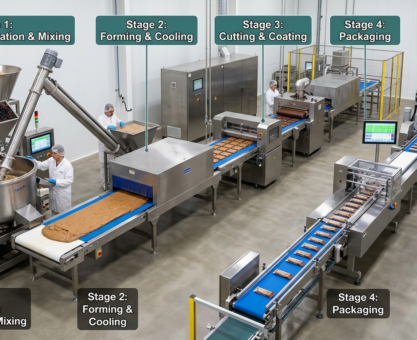

Producing light, crisp corn puffs at commercial scale involves far more than feeding corn grits into an extruder and applying seasoning. The final snack depends on a chain of controlled operations, including raw-material preparation, moisture adjustment, extrusion cooking, die design, cutting, drying or toasting, seasoning, cooling, inspection, and packaging.
A small change in feed moisture, barrel conditions, screw configuration, die geometry, or drying can alter expansion, density, texture, colour, flavour retention, and shelf stability. That is why understanding the complete corn puff manufacturing process is important for manufacturers planning a new plant, evaluating equipment, troubleshooting inconsistent products, or improving an existing line.
This guide explains how corn puffs are made from prepared corn material through packaged snack production. It also covers the equipment involved, process variables, quality-control checkpoints, common production problems, line-selection considerations, and situations where specialist formulation or process-engineering support can be valuable.
What Is the Corn Puff Manufacturing Process?
The corn puff manufacturing process is a controlled food-extrusion process in which a prepared corn-based feed is cooked under heat, moisture, pressure, and mechanical shear, then forced through a shaped die. As the hot material exits the die, pressure drops rapidly and part of the water in the extrudate flashes into vapour. The material expands, creating the characteristic porous structure of a puffed snack.
A commercial process commonly includes:
- Raw-material receiving and inspection
- Cleaning and preparation
- Milling or sizing where required
- Ingredient blending
- Moisture conditioning
- Extrusion cooking
- Die forming and cutting
- Drying, toasting, or further thermal treatment
- Cooling
- Seasoning
- Final inspection
- Weighing and packaging
- Finished-product storage and distribution
The exact arrangement depends on the product formula and the desired finished texture.
What Makes Corn Puff Production Different From Ordinary Corn Processing?
Corn puffs are engineered to develop expansion during processing.
The process must therefore control:
- Starch behaviour
- Feed moisture
- Dough temperature
- Mechanical energy input
- Residence time
- Pressure at the die
- Die opening and geometry
- Cutting conditions
- Post-extrusion moisture removal
- Surface oil or seasoning application
- Packaging conditions
The objective is not simply to cook corn. The objective is to produce a specific structure after cooking and expansion.
How Are Corn Puffs Made?
At a simplified level, how corn puffs are made can be described as a transformation from a controlled corn-based feed into a cooked, expanded extrudate.
The basic sequence is:
Corn grits or flour → cleaning and preparation → blending → moisture conditioning → extrusion cooking → die expansion → cutting → drying or toasting → seasoning → cooling → packaging
Each stage affects the next one.
For example:
- Poor raw-material consistency can make extrusion unstable.
- Incorrect moisture can reduce expansion or produce an irregular structure.
- An unsuitable die can produce inconsistent shapes.
- Inadequate drying can leave the product soft or reduce shelf stability.
- Seasoning before adequate cooling can affect adhesion and product quality.
- Packaging with excessive residual moisture can compromise crispness.
For this reason, a corn puff production line should be considered as an integrated process rather than a collection of unrelated machines.
Raw Materials Used in Corn Puff Manufacturing
Corn is the principal ingredient in many puffed corn snacks, but commercial formulas can contain several additional components.
Depending on the product, the formulation may include:
- Corn grits
- Corn meal
- Corn flour
- Rice or other cereal ingredients
- Legume ingredients
- Starch
- Salt
- Sugar
- Vegetable oils or fats
- Seasoning blends
- Flavouring ingredients
- Colouring ingredients where permitted
- Functional ingredients intended to modify texture or nutrition
The formulation determines how the material behaves inside the extruder.
Selecting Corn Grits
Corn grits are frequently used because their particle characteristics can be suitable for extrusion.
Important raw-material considerations include:
- Particle-size distribution
- Moisture content
- Starch characteristics
- Kernel variety and processing history
- Cleanliness
- Foreign-material control
- Storage condition
- Consistency between batches
A raw material can meet a basic purchasing specification yet still behave differently during extrusion if its physical characteristics vary significantly.
Why Particle Size Matters
Particle size influences:
- Water absorption
- Hydration rate
- Feeding behaviour
- Melting and cooking behaviour
- Residence characteristics
- Extrudate structure
Very coarse material may hydrate less uniformly. Excessively fine material can behave differently in feeding and may affect bulk density or process stability.
The correct particle distribution is therefore a formulation and process-development consideration rather than a universal number that applies to every corn puff.
Raw-Material Storage
Raw materials should be protected from:
- Excessive moisture
- Pest contamination
- Foreign materials
- Uncontrolled temperature and humidity
- Cross-contamination
- Poor stock rotation
Storage problems can eventually become extrusion problems.
A well-designed receiving and storage system should allow:
- Lot identification
- Incoming inspection
- Controlled transfer
- Cleaning or screening
- Traceability
- Appropriate stock rotation
Stage 1: Cleaning and Raw-Material Preparation
Before extrusion, incoming corn material should be evaluated and prepared for processing.
Cleaning may involve equipment such as:
- Vibratory or rotary sieves
- Magnetic separators
- Aspirators
- Destoners
- Screening systems
- Other appropriate foreign-material removal equipment
The precise equipment depends on the raw material and risk profile.
Why Cleaning Matters
Extrusion equipment is designed to process the intended formulation, not foreign materials.
Unwanted material can create:
- Equipment damage
- Product contamination
- Feeding instability
- Quality defects
- Increased maintenance requirements
Raw-material preparation also establishes a more consistent starting point for the downstream process.
Stage 2: Milling, Grinding, or Sizing
Some formulations can use purchased grits directly. Others require additional milling.
The purpose of milling may be to achieve:
- A defined particle-size range
- Better blending
- More predictable hydration
- Suitable feeding characteristics
- Consistent extrusion behaviour
The milling step should be selected according to the formulation and extruder rather than treated as an isolated operation.
Avoid Excessive Grinding
Over-processing the raw material can increase energy consumption and may change flow or hydration behaviour.
A useful production approach is to define a target particle distribution and verify incoming material against it.
Stage 3: Ingredient Blending
The prepared corn material is combined with other dry ingredients when required.
A blending system may include:
- Batch mixers
- Continuous mixers
- Powder dosing equipment
- Micro-ingredient feeders
- Liquid addition systems
Uniform blending is essential because the extruder receives the blend as its feed.
Poor mixing can cause:
- Uneven salt distribution
- Variable flavour intensity
- Localised formulation differences
- Inconsistent expansion
- Batch-to-batch variation
Dry Ingredients Versus Liquid Ingredients
Dry components can usually be incorporated through controlled powder dosing.
Water may be introduced separately during conditioning or through a mixing system.
Oil can also be incorporated at different stages depending on formulation and process design.
The chosen approach should be validated experimentally because ingredient addition can affect hydration and extrusion behaviour.
Stage 4: Moisture Conditioning
Moisture is one of the most important variables in the corn puff manufacturing process.
Before or during extrusion, the feed needs an appropriate moisture condition for cooking and expansion.
Water affects:
- Starch plasticisation
- Heat transfer
- Viscosity
- Mechanical energy requirements
- Die pressure
- Expansion
- Cell formation
- Final texture
The correct moisture level depends on the formula, equipment configuration, product geometry, and desired texture.
Why Moisture Is So Important
Consider two feeds with the same corn composition.
If one contains substantially more available water, the material may behave differently inside the extruder because water acts as a plasticising component.
Changes in moisture can influence:
- Melt viscosity
- Pressure development
- Residence behaviour
- Expansion at the die
- Final density
- Drying load
This is why moisture should be controlled through measurement rather than judged solely by appearance.
Stage 5: Extrusion Cooking
Extrusion is the central operation in most puff snack manufacturing systems.
An extruder generally consists of:
- Feed hopper
- Feeding mechanism
- Barrel
- Screw or screw assembly
- Heating and cooling system
- Die
- Cutter
Inside the barrel, the feed is transported while being exposed to mechanical energy and controlled thermal conditions.
What Happens Inside the Extruder?
A simplified sequence is:
- The feed enters the extruder.
- The screw transports the material forward.
- Water and heat promote hydration and cooking.
- Mechanical shear contributes energy and mixing.
- Starch undergoes structural changes during cooking.
- Pressure develops toward the die.
- The cooked material becomes a deformable extrudate.
- The material exits through the die.
- Pressure drops at the outlet.
- Moisture expansion creates a porous structure.
The exact physical behaviour depends strongly on the formulation and machine configuration.
Understanding Extrusion Parameters
A successful corn puff production line requires coordinated control rather than optimisation of a single parameter.
Important variables include:
- Feed rate
- Feed moisture
- Screw speed
- Barrel temperature profile
- Screw configuration
- Die design
- Pressure
- Specific mechanical energy
- Residence time
- Cutter speed
- Product throughput
Changing one variable can alter several others.
Feed Rate
Feed rate affects the amount of material entering the extruder over time.
Increasing feed rate can change:
- Fill level
- Residence time
- Torque
- Pressure
- Energy input per unit mass
- Product temperature
A higher throughput target therefore should not automatically be achieved by simply increasing the feeder.
Screw Speed
Screw speed influences:
- Conveying
- Shear
- Mixing
- Residence behaviour
- Energy input
- Melt conditions
The appropriate operating range depends on the machine and formulation.
Barrel Temperature
Temperature affects cooking and melt properties.
A barrel commonly contains multiple controlled zones so that the material can experience a defined thermal profile.
However, barrel setpoint temperature is not necessarily identical to the actual material temperature.
That distinction matters during process development.
Specific Mechanical Energy
Specific mechanical energy, often abbreviated SME, describes mechanical energy input relative to processed material.
It can help engineers understand how operating conditions affect cooking and structure.
SME should not be treated as an independent control target without considering moisture, formulation, screw configuration, and product requirements.
The Role of Starch in Corn Puff Expansion
Starch is central to the structure of many corn-based extruded snacks.
During extrusion cooking, starch granules are exposed to:
- Heat
- Water
- Pressure
- Shear
The resulting structural transformation contributes to the cooked melt that expands after leaving the die.
Expansion depends on more than starch alone.
Other influences include:
- Moisture
- Temperature
- Melt viscosity
- Die pressure
- Formulation
- Screw configuration
- Cooling rate after die exit
A useful way to understand the process is to view the extruder as a system that creates a cooked material with physical properties suitable for controlled expansion.
Stage 6: Die Design and Product Shape
The die determines the cross-sectional shape of the extrudate.
Common puffed snack forms include:
- Rods
- Tubes
- Rings
- Stars
- Balls
- Wheels
- Irregular pieces
- Other shaped profiles
The die opening, land length, geometry, and flow distribution can influence the product.
Why Die Design Matters
A die that produces uneven flow can create:
- Variable dimensions
- Uneven density
- Poor shape definition
- Irregular expansion
- Cutter problems
Die design should therefore be considered together with the formulation and extruder.
Changing die geometry may require corresponding changes in:
- Throughput
- Moisture
- Screw speed
- Cutter settings
- Drying conditions
Stage 7: Cutting the Extrudate
After the material exits the die, a cutter separates the continuous extrudate into individual pieces when the product design requires it.
Cutting systems may use rotating knives or other suitable mechanisms.
Cut quality depends on:
- Extrudate consistency
- Cutter speed
- Knife condition
- Die geometry
- Product temperature
- Throughput
Poor cutting can result in:
- Long tails
- Deformed pieces
- Uneven lengths
- Crushed product
- Excessive fines
Cutter adjustment should therefore be part of routine production control.
Stage 8: Drying or Toasting
Freshly extruded snacks can contain more moisture than desired for the finished product.
Drying reduces moisture and helps establish the intended:
- Crispness
- Texture
- Density perception
- Storage stability
Depending on the product, drying can involve hot-air treatment, toasting, or another controlled thermal process.
Why Drying Requires Control
Over-drying can produce:
- Excessive hardness
- Fragility
- Colour changes
- Unnecessary energy consumption
Under-drying can contribute to:
- Soft texture
- Poor crispness
- Reduced storage stability
- Moisture migration problems
The target should therefore be based on the finished product specification rather than simply maximising moisture removal.
Stage 9: Cooling
After drying or thermal treatment, the product should generally be cooled before packaging.
Cooling allows the product to reach a condition appropriate for:
- Seasoning
- Handling
- Inspection
- Packaging
Packaging product while it is excessively warm can affect the package environment and may contribute to condensation or other quality problems under unsuitable conditions.
Stage 10: Seasoning
Seasoning is usually applied after the puff has developed its structure.
Depending on the formulation, the process can include:
- Controlled oil application
- Powder seasoning addition
- Tumbling or conveying
- Distribution and adhesion
- Final inspection
Seasoning systems may use:
- Rotary drums
- Tumble coaters
- Vibratory systems
- Oil spraying systems
- Powder dosing equipment
Seasoning Adhesion
Seasoning adhesion depends on several factors.
Important considerations include:
- Product surface characteristics
- Surface oil level
- Powder particle properties
- Seasoning feed rate
- Product temperature
- Residence time
- Mixing intensity
Too little adhesion can produce weak flavour coverage and seasoning loss in the package.
Excessive oil can create an undesirable surface condition and alter nutritional and sensory characteristics.
Stage 11: Final Quality Inspection
Quality control should extend across the complete process.
A useful control programme may examine:
Raw Materials
- Moisture
- Particle size
- Appearance
- Foreign-material control
- Ingredient identity
- Lot information
Extrusion
- Feed rate
- Feed moisture
- Screw speed
- Temperature profile
- Pressure
- Torque or load indicators
- Product dimensions
Finished Snack
- Moisture
- Texture
- Density or expansion characteristics
- Shape
- Colour
- Seasoning coverage
- Broken pieces
- Fines
- Packaging integrity
The exact tests should reflect the product specification and applicable food-safety system.
Stage 12: Packaging Corn Puffs
Packaging is the final major step in the corn puff manufacturing process, but it should be considered during product development rather than only after production is complete.
Puffed snacks are generally sensitive to moisture because crispness depends on their low-moisture structure.
Packaging must therefore provide appropriate protection against:
- Moisture ingress
- Oxygen exposure where relevant
- Physical damage
- Contamination
- Loss of seal integrity
Common packaging formats can include:
- Flexible pouches
- Pillow bags
- Laminated film structures
- Multi-layer barrier packaging
- Larger bulk packs for certain applications
The exact material should be selected according to the product, storage conditions, distribution environment, required shelf life, and packaging equipment.
The Complete Corn Puff Production Line
A typical corn puff production line may be organised into the following sections:
- Raw-material receiving
- Cleaning and screening
- Ingredient storage
- Dosing and weighing
- Mixing
- Conditioning
- Extrusion
- Die forming
- Cutting
- Drying or toasting
- Cooling
- Seasoning
- Conveying
- Inspection
- Weighing
- Packaging
- Finished-product handling
The exact configuration depends on:
- Product shapes
- Formula
- Required capacity
- Automation level
- Number of products
- Available floor space
- Labour model
- Utility availability
- Packaging format
- Quality requirements
Corn Puff Manufacturing Equipment
The equipment required for puff snack manufacturing should be selected as a connected system.
Raw-Material Handling Equipment
Typical equipment can include:
- Storage bins
- Hoppers
- Conveyors
- Bucket elevators
- Pneumatic conveying systems
- Sieves
- Magnets
- Destoners
The selection depends on the material properties and plant design.
Mixing and Conditioning Equipment
Possible equipment includes:
- Batch mixers
- Continuous mixers
- Water dosing systems
- Liquid dosing equipment
- Conditioning vessels
The key requirement is consistent feed preparation.
Extruder
The extruder is the main processing machine.
A suitable extruder must match:
- Formulation
- Product geometry
- Throughput requirement
- Desired expansion
- Thermal processing requirements
- Degree of process flexibility
Both single-screw and twin-screw systems can be used in food extrusion, although their operating characteristics differ.
Single-Screw Extruders
Single-screw systems can be suitable for formulations where consistent conveying and relatively straightforward processing are required.
Potential advantages include:
- Simpler mechanical configuration
- Established operating principles
- Suitable processing for many cereal-based products
The suitability depends on the application.
Twin-Screw Extruders
Twin-screw systems provide strong mixing and process flexibility.
They may be useful where the formulation requires:
- Intensive mixing
- More complex ingredient combinations
- Controlled feeding of multiple components
- Greater process flexibility
Twin-screw equipment can also involve greater mechanical and control complexity.
There is no universally superior extruder. The correct choice depends on the formulation, product design, capacity, and process objectives.
Drying Equipment
Drying systems may include:
- Multi-pass dryers
- Belt dryers
- Hot-air ovens
- Fluidised systems for suitable products
- Toasting ovens
Selection should consider:
- Product geometry
- Residence time
- Heat-transfer characteristics
- Moisture-removal target
- Space requirements
- Energy use
- Cleaning requirements
Uniform airflow is particularly important for products with varying thickness or irregular geometry.
Seasoning Equipment
A seasoning section can include:
- Oil sprayers
- Powder feeders
- Tumbling drums
- Conveyors
- Vibratory distribution systems
The system should provide controlled product movement and consistent seasoning exposure.
Packaging Equipment
Packaging equipment can include:
- Multihead weighing systems
- Volumetric systems where appropriate
- Vertical form-fill-seal machines
- Bagging machines
- Checkweighers
- Metal detection or other appropriate inspection systems
- Date and batch coding equipment
Packaging selection depends heavily on the final pack format and product characteristics.
Process Variables That Control Expansion
Expansion is one of the most visible characteristics of a puffed snack.
Important variables include:
- Feed moisture
- Feed composition
- Starch properties
- Barrel temperature
- Screw speed
- Feed rate
- Mechanical energy
- Die geometry
- Pressure
- Cooling conditions
What Happens When Expansion Is Too Low?
Low expansion can produce a product that is:
- Dense
- Hard
- Less crisp
- Visually smaller
- Heavier for its volume
Potential causes include:
- Excessive feed moisture
- Insufficient cooking
- Unsuitable formulation
- Poor die conditions
- Incorrect screw configuration
- Inadequate energy input
- Process instability
However, the same symptom can have different causes on different lines.
Troubleshooting should therefore use process data rather than changing several variables simultaneously.
What Causes Excessive Expansion?
Very high expansion can also be undesirable.
It may produce:
- Fragile pieces
- Thin walls
- Excessive breakage
- Poor shape stability
- Low mechanical strength
Potential contributors can include:
- Feed moisture
- High energy input
- Formulation characteristics
- Die conditions
- Rapid pressure release
The desired expansion should be defined by the product specification.
Density and Texture Control
Density is closely related to the internal cell structure created during extrusion and subsequent drying.
A product can have high visual expansion but still exhibit an undesirable texture if the cell structure is unstable.
Texture depends on:
- Cell size
- Cell-wall thickness
- Moisture
- Starch transformation
- Drying history
- Formulation
- Seasoning and surface treatment
This is why visual inspection alone is insufficient for process validation.
Moisture Control in Corn Puff Manufacturing
Moisture has two distinct roles.
During extrusion, water helps the material cook and flow.
After processing, excessive water can reduce crispness and negatively affect storage performance.
The production team therefore needs to distinguish between:
- Processing moisture
- Finished-product moisture
- Moisture distribution within the product
- Environmental moisture exposure
A stable process requires measurement at appropriate points.
Colour Control
Colour can be affected by:
- Raw-material characteristics
- Thermal processing
- Residence time
- Drying temperature
- Formulation
- Surface seasoning
- Oxidative changes where relevant
Excessive thermal exposure can cause unwanted darkening.
However, a darker product does not automatically indicate one specific process problem. Colour should be interpreted alongside moisture, temperature, formulation, and other process measurements.
Seasoning Quality Control
A seasoning system should be evaluated for:
- Uniform coverage
- Powder adhesion
- Oil distribution
- Flavour consistency
- Seasoning loss
- Product breakage
Useful process checks can include sampling product from different points or production periods to determine whether distribution remains consistent.
Common Problems in Corn Puff Production
Problem 1: Low Expansion
Possible causes:
- Incorrect feed moisture
- Inadequate cooking
- Unsuitable formulation
- Inappropriate screw configuration
- Die restrictions
- Process instability
Practical response
Review the process systematically:
- Verify raw-material characteristics.
- Confirm feed moisture.
- Review extrusion temperature.
- Check screw speed and feed rate.
- Examine die condition.
- Compare pressure and load data with stable production.
- Change one major variable at a time where practical.
Problem 2: Uneven Shape
Potential causes include:
- Uneven die flow
- Cutter instability
- Feed fluctuations
- Die wear
- Inconsistent melt conditions
The first step should be to determine whether the variation begins before or after the die.
Problem 3: Soft Final Product
Possible causes include:
- Excess residual moisture
- Inadequate drying
- Moisture absorption after drying
- Packaging leakage
- Environmental humidity exposure
The solution may involve both processing and packaging investigation.
Problem 4: Excessive Breakage
Possible causes include:
- Excessively fragile cell structure
- Over-expansion
- Mechanical handling
- Conveyor drops
- Aggressive seasoning
- Packaging operations
Breakage should be traced through the line to identify where damage occurs.
Problem 5: Poor Seasoning Adhesion
Potential causes include:
- Insufficient surface oil
- Incorrect seasoning particle characteristics
- Poor tumbler performance
- Incorrect feed rates
- Product surface condition
Increasing seasoning quantity alone may not solve the problem.
Problem 6: Inconsistent Product Between Batches
Possible contributors include:
- Raw-material variation
- Incorrect moisture conditioning
- Feeder calibration
- Temperature variation
- Operator adjustments
- Equipment wear
- Inconsistent seasoning dosing
Batch records and process trends can help distinguish formulation problems from equipment problems.
Common Mistakes in Corn Puff Manufacturing
Mistake 1: Treating the Extruder as the Entire Process
The extruder is central, but final product quality also depends on:
- Raw materials
- Conditioning
- Die design
- Cutting
- Drying
- Seasoning
- Packaging
A good extruder cannot compensate indefinitely for poor upstream or downstream control.
Mistake 2: Changing Multiple Variables at Once
If moisture, temperature, screw speed, and feed rate are changed simultaneously, it becomes difficult to identify which adjustment caused the improvement or deterioration.
Controlled trials are generally more informative.
Mistake 3: Ignoring Raw-Material Variation
Two batches of corn material can behave differently.
Incoming specifications should therefore address relevant physical and chemical properties.
Mistake 4: Selecting Capacity Before Defining the Product
A high-throughput machine is not automatically the correct machine.
Product shape, formula, texture, expansion, and packaging requirements should be established before final equipment selection.
Mistake 5: Underestimating Drying
Extrusion may create the desired structure, but drying helps establish the final texture and moisture condition.
Dryer performance should therefore receive the same attention as extrusion.
Mistake 6: Designing Packaging Too Late
Packaging should be tested with the finished product because moisture migration, seal integrity, and mechanical protection can affect actual shelf performance.
How to Select a Corn Puff Production Line
A practical equipment-selection process should begin with the product rather than the machine catalogue.
Step 1: Define the Product
Specify:
- Base ingredients
- Shape
- Size
- Expansion characteristics
- Texture
- Flavour
- Seasoning method
- Finished moisture target
- Packaging format
Step 2: Define Production Requirements
Determine:
- Desired output
- Operating schedule
- Product range
- Labour availability
- Automation requirements
- Available floor area
Capacity should be expressed using a realistic operating basis rather than an ideal theoretical maximum.
Step 3: Evaluate the Process
Determine which operations are required:
- Cleaning
- Milling
- Mixing
- Conditioning
- Extrusion
- Cutting
- Drying
- Cooling
- Seasoning
- Packaging
Not every product requires the same equipment sequence.
Step 4: Evaluate Utilities
Consider:
- Electrical power
- Water
- Compressed air
- Heating source
- Ventilation
- Exhaust
- Drainage
- Waste handling
Utilities can materially influence plant design and operating cost.
Step 5: Evaluate Hygiene and Accessibility
Equipment should be designed for practical:
- Cleaning
- Inspection
- Maintenance
- Product changeover
- Sanitation
- Access to wear components
A machine that performs well but is difficult to clean can create operational problems.
Automation in Corn Puff Manufacturing
Automation can be applied at multiple levels.
Lower Automation
Operators may manually perform:
- Ingredient weighing
- Some transfers
- Seasoning adjustment
- Packaging tasks
Higher Automation
Automated systems can control:
- Ingredient dosing
- Water addition
- Feed rate
- Extrusion conditions
- Dryer settings
- Seasoning dosing
- Weighing
- Packaging
- Data collection
Automation can improve repeatability, but it does not replace process development.
Poorly defined process conditions can simply become automatically repeated poor conditions.
Process Development Before Commercial Production
Before committing to a full corn puff production line, product development trials can be valuable.
Trials can help establish:
- Suitable formulation
- Feed moisture range
- Extrusion behaviour
- Expansion characteristics
- Die selection
- Drying requirements
- Seasoning performance
- Packaging suitability
Trial work is particularly useful when introducing:
- A new formulation
- A new cereal base
- A new product shape
- A new seasoning
- A new extruder configuration
Using Data for Process Control
A modern puff snack manufacturing operation benefits from recording process variables systematically.
Useful data can include:
- Raw-material lot
- Feed moisture
- Feed rate
- Screw speed
- Barrel temperatures
- Pressure
- Torque
- Product dimensions
- Finished moisture
- Dryer conditions
- Seasoning rate
- Package weight
Trend analysis can reveal gradual drift before the final product falls outside specification.
Preventive Maintenance
Extrusion equipment operates under significant mechanical and thermal loads.
Maintenance planning should address:
- Screw components
- Barrel components
- Bearings
- Seals
- Feed systems
- Die components
- Cutters
- Dryer belts
- Fans
- Heating systems
- Conveyors
- Seasoning equipment
- Packaging equipment
Why Die and Cutter Maintenance Matters
The die controls the initial product profile.
The cutter controls the final piece length and shape.
Wear in either component can gradually change product appearance.
Routine inspection can therefore prevent small deviations from becoming major quality problems.
Hygiene and Food-Safety Considerations
Food extrusion plants should incorporate appropriate hygienic design and food-safety controls.
Important considerations include:
- Raw-material segregation
- Cleaning procedures
- Allergen management where applicable
- Pest control
- Foreign-material control
- Personnel hygiene
- Equipment sanitation
- Traceability
- Environmental controls where relevant
- Verification of cleaning effectiveness
Regulatory requirements vary by jurisdiction and product category. Manufacturers should determine applicable requirements with qualified food-safety and regulatory professionals rather than assuming that one set of rules applies universally.
When Professional Expertise Becomes Valuable
Some projects can be developed internally. Others benefit from specialist assistance.
Professional process or engineering support may be appropriate when:
- A new formulation behaves unpredictably during extrusion.
- Product expansion varies substantially between trials.
- A plant is being designed from the ground up.
- Utility requirements need detailed engineering.
- Multiple machines must be integrated.
- Product development requires controlled extrusion trials.
- Packaging and shelf-life performance need validation.
- Regulatory or food-safety requirements are complex.
- A major capacity expansion is being planned.
Specialists can contribute through:
- Process trials
- Formulation optimisation
- Equipment sizing
- Factory-layout planning
- Utility calculations
- Automation design
- Quality-system development
- Packaging validation
- Troubleshooting
The objective should be measurable process performance, not simply equipment acquisition.
Cost Factors in Corn Puff Production
There is no universal price for a complete corn puff production line because project cost depends on configuration.
Important cost factors include:
- Production capacity
- Extruder type
- Automation level
- Raw-material handling
- Number of processing stages
- Dryer design
- Seasoning system
- Packaging machinery
- Installation requirements
- Utilities
- Factory modifications
- Product changeover requirements
- Quality-control equipment
- Spare parts
- Maintenance requirements
Capital Cost Versus Operating Cost
A lower initial equipment cost does not necessarily mean a lower total cost of ownership.
Operating expenses may be affected by:
- Energy consumption
- Labour
- Maintenance
- Product losses
- Seasoning usage
- Packaging material
- Cleaning time
- Downtime
- Changeover losses
A proper equipment evaluation should therefore consider lifecycle economics.
Energy Considerations
Energy is consumed through several parts of the process:
- Extrusion
- Drying
- Heating
- Air movement
- Conveying
- Compressed air
- Packaging
Drying can be an important energy-consuming stage because water removal requires thermal energy.
Energy-efficiency evaluation should therefore consider the complete line rather than only the extruder motor.
Product Changeovers
Manufacturers producing multiple flavours or shapes need to consider changeover requirements.
A changeover may involve:
- Stopping product flow.
- Removing remaining material.
- Cleaning relevant equipment.
- Changing dies or cutters where necessary.
- Adjusting formulation or dosing.
- Establishing new operating conditions.
- Verifying product quality.
- Restarting normal production.
The shorter the validated changeover procedure, the more practical multi-product manufacturing can become.
Packaging and Shelf-Life Performance
A puffed snack can leave the production line in excellent condition and still deteriorate during storage.
Important causes can include:
- Moisture ingress
- Poor seals
- Inappropriate packaging material
- Excessive oxygen exposure where oxidation is relevant
- Temperature fluctuations
- Mechanical damage
- Insufficient package protection
Shelf-life studies should therefore evaluate the actual product and intended package under appropriate storage conditions.
Shelf life should not be inferred solely from the initial moisture measurement.
Troubleshooting Framework for Corn Puff Manufacturing
When a production problem occurs, use a structured sequence.
Check 1: Raw Materials
Ask:
- Did the ingredient lot change?
- Is moisture within specification?
- Has particle size changed?
- Was the formulation prepared correctly?
Check 2: Feed System
Check:
- Feeder calibration
- Feed rate
- Flow consistency
- Conditioning water addition
Check 3: Extrusion
Review:
- Screw speed
- Barrel temperatures
- Pressure
- Load or torque
- Residence behaviour
- Die condition
Check 4: Post-Extrusion Processing
Review:
- Cutter speed
- Dryer conditions
- Cooling
- Seasoning
- Conveying
Check 5: Packaging
Check:
- Package weight
- Seal integrity
- Film condition
- Product temperature at packaging
- Storage environment
This approach helps isolate the source instead of treating every defect as an extrusion problem.
Practical Quality-Control Checklist
A production team can use the following checklist during routine operation.
Before Production
- Confirm approved raw-material lots.
- Verify ingredient identity.
- Check moisture where specified.
- Inspect cleaning and conveying equipment.
- Confirm feeder settings.
- Check extrusion equipment.
- Inspect die and cutter condition.
- Verify dryer readiness.
- Confirm seasoning materials.
- Verify packaging materials.
During Production
- Monitor feed consistency.
- Record relevant extrusion parameters.
- Inspect product dimensions.
- Monitor expansion.
- Check drying performance.
- Verify seasoning coverage.
- Inspect for breakage and fines.
- Check package weights.
- Check seals and coding.
After Production
- Record final production data.
- Complete required quality checks.
- Identify deviations.
- Perform cleaning.
- Inspect wear components.
- Store finished goods under suitable conditions.
- Maintain traceability records.
How to Improve Corn Puff Production Efficiency
Efficiency improvements should begin with the largest sources of loss.
Potential areas include:
- Raw-material waste
- Extruder downtime
- Dryer inefficiency
- Product breakage
- Seasoning loss
- Packaging rejects
- Excessive changeover time
- Unplanned maintenance
- Inconsistent formulation
Reduce Variation Before Increasing Speed
Increasing line speed can magnify an unstable process.
A more reliable sequence is:
- Establish stable formulation.
- Establish stable feed moisture.
- Stabilise extrusion.
- Stabilise drying.
- Stabilise seasoning.
- Stabilise packaging.
- Measure losses.
- Increase throughput gradually.
- Revalidate product quality.
This approach provides a better basis for capacity improvement.
Scaling From Pilot to Commercial Production
Pilot trials do not automatically translate into commercial production.
Scaling can change:
- Residence time
- Heat transfer
- Feed behaviour
- Screw filling
- Die pressure
- Drying performance
- Seasoning distribution
A formulation that works on one extruder may require adjustment on another machine.
For this reason, scale-up should compare process behaviour rather than simply multiplying the pilot throughput by a numerical factor.
Choosing Between Different Extrusion Technologies
When evaluating food extrusion equipment, compare:
Processing capability
Can the machine produce the required:
- Shape?
- Expansion?
- Texture?
- Throughput?
Formulation flexibility
Can it handle planned changes in:
- Corn content?
- Moisture?
- Additional cereals?
- Functional ingredients?
Control capability
Can operators reliably control:
- Feed rate?
- Screw speed?
- Temperature?
- Moisture?
- Pressure?
Maintenance
Evaluate:
- Wear parts
- Access
- Cleaning
- Spare parts
- Service requirements
Integration
Confirm compatibility with:
- Feeders
- Dryers
- Seasoning systems
- Conveyors
- Packaging
A machine should be evaluated as part of the complete manufacturing system.
Environmental and Waste Considerations
Corn puff production generates several potential waste streams.
These can include:
- Product fines
- Broken pieces
- Off-specification product
- Packaging waste
- Cleaning residues
- Wastewater where wet cleaning is used
Waste reduction opportunities may include:
- Better cutter control
- Improved conveying
- Optimised drying
- Accurate seasoning dosing
- Controlled startup and shutdown procedures
- Reduced changeover losses
Any reuse of off-specification product must be evaluated against food-safety, quality, formulation, and regulatory requirements.
What Makes a Consistent Corn Puff?
Consistency comes from controlling the complete process.
A reliable product generally requires:
- Consistent raw materials
- Controlled moisture
- Stable feeding
- Reproducible extrusion
- Appropriate die design
- Controlled cutting
- Uniform drying
- Consistent seasoning
- Effective packaging
The most important principle is process integration.
If upstream conditions fluctuate, downstream equipment often has to compensate. Excessive compensation makes the process harder to operate and troubleshoot.
Frequently Asked Questions About Corn Puff Manufacturing
Question: What is the corn puff manufacturing process?
Answer: The corn puff manufacturing process typically involves preparing corn-based raw material, blending and conditioning it with controlled moisture, extrusion cooking, die forming, cutting, drying or toasting, cooling, seasoning, inspection, and packaging. The exact sequence depends on the product formulation and desired characteristics.
Question: How are corn puffs made in a factory?
Answer: How corn puffs are made commercially usually involves extrusion cooking. Corn grits or another suitable corn-based feed are conditioned and processed through an extruder. The cooked material exits through a shaped die, expands as pressure falls, is cut into pieces, dried, seasoned, cooled, and packaged.
Question: What raw material is used for corn puffs?
Answer: Corn grits, corn meal, or corn flour can be used depending on the product and extrusion system. Other cereal ingredients, starches, seasonings, oils, and formulation components may also be included.
Question: Why is moisture important in corn puff production?
Answer: Moisture affects starch plasticisation, heat transfer, melt viscosity, pressure development, expansion, and final texture. Too much or too little moisture can change extrusion stability and the characteristics of the finished puff.
Question: What machine is used to make corn puffs?
Answer: An extrusion cooker or food extruder is the principal machine used for many puffed corn products. A complete corn puff production line can also include mixers, conditioners, dryers, cooling conveyors, seasoning systems, weighing equipment, and packaging machines.
Question: Can a single-screw extruder make corn puffs?
Answer: Yes, suitable single-screw food extruders can be used for various corn-based puffed products. Suitability depends on the formulation, product shape, expansion requirements, throughput, and machine configuration.
Question: Can twin-screw extrusion be used for corn puffs?
Answer: Yes. Twin-screw extrusion can provide strong mixing and process flexibility and may be appropriate for formulations containing multiple ingredients. The correct technology depends on the product and process-development requirements.
Question: What controls corn puff expansion?
Answer: Expansion is influenced by feed moisture, formulation, starch characteristics, temperature, screw speed, mechanical energy, pressure, die geometry, and post-extrusion conditions. No single variable determines expansion across every formulation.
Question: Why are my corn puffs too dense?
Answer: High density can result from unsuitable feed moisture, insufficient cooking, formulation differences, inappropriate extrusion conditions, die restrictions, or other process problems. Troubleshooting should compare the current process against a stable reference condition.
Question: Why are corn puffs soft after production?
Answer: Softness can result from excessive residual moisture, inadequate drying, moisture absorption after processing, or packaging problems. Both the dryer and packaging system should be investigated.
Question: Why do corn puffs break easily?
Answer: Excessive expansion, fragile cell structure, aggressive conveying, cutter problems, seasoning equipment, or packaging operations can contribute to breakage. The production line should be inspected sequentially to identify where damage occurs.
Question: What does the dryer do in puff snack manufacturing?
Answer: The dryer removes moisture from the freshly extruded product to establish the desired texture and finished moisture condition. Dryer design and operating conditions should be matched to product geometry and the required moisture reduction.
Question: When should seasoning be added?
Answer: Seasoning is commonly applied after extrusion and after the product has developed its desired structure. The exact location depends on the formulation, oil system, seasoning characteristics, and process design.
Question: How is seasoning applied to corn puffs?
Answer: Seasoning can be applied using controlled oil spraying, powder dosing, tumbling, or other distribution systems. Good coverage depends on product surface condition, oil level, seasoning properties, dosing, and mixing.
Question: What packaging is suitable for corn puffs?
Answer: Packaging should provide appropriate protection against moisture and physical damage and, where relevant, oxygen exposure. Flexible barrier films and laminated structures are common approaches, but the correct material depends on the product, storage environment, equipment, and required shelf life.
Question: Does packaging affect corn puff crispness?
Answer: Yes. Puffed snacks can lose crispness if they absorb moisture from the surrounding environment. Package barrier properties and seal integrity therefore form an important part of finished-product quality.
Question: How much does a corn puff production line cost?
Answer: There is no single reliable price because equipment cost depends on capacity, automation, extrusion technology, drying system, seasoning, packaging, installation, utilities, and the number of product formats. A meaningful project estimate requires a defined process and equipment scope.
Question: What capacity should a corn puff production line have?
Answer: Capacity should be based on realistic sales requirements, operating hours, product mix, desired utilisation, and packaging capability. The nominal output of the extruder should not be considered in isolation because drying and packaging can become downstream constraints.
Question: What quality checks are important for corn puffs?
Answer: Relevant checks can include raw-material moisture and particle characteristics, extrusion conditions, product dimensions, expansion, finished moisture, texture, seasoning distribution, package weight, seal integrity, and other product-specific specifications.
Question: How can corn puff production problems be diagnosed?
Answer: Begin with raw materials and feed preparation, then review extrusion conditions, die and cutter performance, drying, seasoning, conveying, and packaging. Process records make it easier to compare abnormal production with a stable reference run.
Question: Is professional process engineering necessary for a corn puff plant?
Answer: It may become valuable when developing new formulations, scaling production, integrating multiple machines, designing utilities, troubleshooting persistent instability, validating packaging, or establishing a new factory. Specialist assistance is particularly useful when several process variables interact.
Question: What should be considered when buying corn puff manufacturing equipment?
Answer: Consider product formulation, desired shapes, throughput, expansion, extrusion technology, drying, seasoning, packaging, automation, utilities, hygiene, cleaning access, maintenance, changeover requirements, spare parts, and integration with upstream and downstream equipment.
Question: Can one extrusion line make different puffed snacks?
Answer: A sufficiently flexible line may produce multiple products, but product changes can require different dies, formulations, moisture conditions, screw configurations, drying parameters, seasoning systems, or packaging formats. Flexibility should be verified through process trials.
Question: What is the biggest mistake when setting up puff snack manufacturing?
Answer: A common mistake is selecting equipment based primarily on nominal capacity without first defining the product and complete process. Product formulation, expansion, drying, seasoning, packaging, utilities, and changeover requirements should all be considered before final equipment selection.
Question: How can manufacturers reduce waste in corn puff production?
Answer: Waste can be reduced through stable feeding, controlled extrusion, accurate cutting, efficient conveying, appropriate drying, controlled seasoning, good packaging operation, and reduced startup and changeover losses. Waste should be measured by process stage so the largest losses can be addressed first.
Question: Does corn variety affect puffing performance?
Answer: Corn characteristics can affect processing behaviour because composition and starch properties influence hydration, cooking, melt behaviour, and expansion. Raw-material specifications and controlled trials are useful when changing suppliers or raw-material types.
Question: Why does the same recipe behave differently on another extruder?
Answer: Extruder geometry, screw configuration, heating and cooling, feed system, residence behaviour, die design, and mechanical energy input can differ between machines. A recipe therefore may require process adjustment when transferred between equipment.
Question: How important is die design in corn puff production?
Answer: Die design influences flow distribution, product shape, pressure conditions, and the material’s behaviour at the outlet. Die selection should be developed together with formulation and extrusion conditions.
Question: What is the role of cooling before packaging?
Answer: Cooling brings the product to an appropriate condition for handling and packaging. Packaging a product under unsuitable thermal conditions can affect the package environment and product quality.
Question: Can corn puffs be produced without seasoning?
Answer: Yes. Seasoning is a product-design choice rather than a requirement for extrusion. Unseasoned puffed products can be manufactured when the desired product does not require surface flavouring.
Question: Is drying always required after extrusion?
Answer: Not every extruded product requires the same post-extrusion treatment. Whether drying or another thermal step is needed depends on the extrusion conditions, formulation, product moisture, texture target, and intended shelf stability.
Final Takeaway
The corn puff manufacturing process is a controlled sequence in which raw-material properties, moisture, extrusion conditions, die geometry, drying, seasoning, and packaging work together to determine the finished snack.
The most important practical lessons are:
- Start with a well-defined formulation and raw-material specification.
- Control feed moisture rather than relying on visual judgement.
- Treat extrusion as a system of interacting variables.
- Match die design to product geometry and process conditions.
- Monitor cutting and conveying because mechanical damage can occur after extrusion.
- Give drying sufficient attention because final texture depends heavily on moisture control.
- Apply seasoning under controlled surface conditions.
- Design packaging around moisture protection and the intended storage environment.
- Record process variables so deviations can be investigated objectively.
- Evaluate the entire corn puff production line, not just the extruder.
- Use pilot trials and structured validation when developing new products or scaling production.
- Bring in specialist process, engineering, food-safety, formulation, or packaging expertise when the interaction between variables exceeds what routine production control can reliably manage.
For manufacturers, the most useful approach is to define the finished product first, map every process stage required to produce it, identify the variables that control each stage, and then select equipment capable of maintaining those conditions consistently.
A well-designed puff snack manufacturing system should therefore be judged not only by its nominal throughput, but by its ability to deliver the required product shape, expansion, texture, moisture, seasoning coverage, packaging integrity, hygiene performance, and repeatability under realistic operating conditions.