
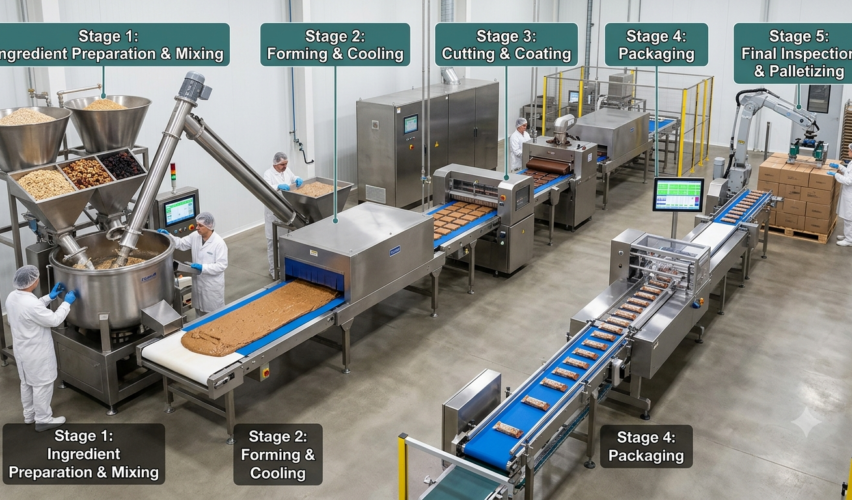
While energy bars look simple on the shelf, there is a significant number of R&D activities for creating a product that will be consistently produced at the commercial scale. It is not enough to develop a bar with an adequate ratio of nutrients and calories; it should also have a desirable texture and not crumble, stick, or become oily or dry during cutting, forming, cooling, or storage.
Understanding the energy bar manufacturing process helps manufacturers identify where these problems originate. It also helps product developers, equipment buyers, quality teams, and production managers connect formulation decisions with processing requirements.
The energy bar making process is therefore more than mixing ingredients and pressing them into a shape. Commercial production requires a controlled sequence in which raw materials, moisture, temperature, mixing energy, forming pressure, cooling conditions, cutting, and packaging work together.
This guide explains how energy bars are manufactured, from raw-material preparation to finished packaging. It also examines commercial energy bar production, equipment considerations, quality-control checkpoints, common manufacturing problems, troubleshooting methods, and factors that influence production-line decisions.
What Is an Energy Bar?
An energy bar is a formulated food product designed to provide concentrated energy and nutrients in a convenient solid or semi-solid format.
Depending on the product concept, an energy bar may contain:
- Cereals and grains
- Oats
- Rice crisps
- Wheat or other grain ingredients
- Nuts and seeds
- Dried fruits
- Nut or seed butters
- Syrups
- Sugar-based ingredients
- Protein ingredients
- Fibres
- Fats and oils
- Flavourings
- Cocoa or chocolate ingredients
- Salt
- Vitamins or minerals
- Functional ingredients
The precise formulation determines the required energy bar manufacturing process.
A soft fruit-and-oat bar may require a different mixing and forming approach from a crunchy cereal bar. A high-protein bar may require tighter control of moisture and mixing energy than a conventional carbohydrate-focused energy bar.
Energy Bar Versus Protein Bar
Energy bars and protein bars could be produced similarly but remain different.
An energy bar usually includes more carbohydrates, cereals, fruits, syrups, or fats and is more concentrated on providing energy for daily use.
Protein bars, in their turn, have more protein, protein powders, crisps, binders, humectants, or texturising agents and are aimed at covering the body’s protein needs in proteins.
The distinction matters during manufacturing because protein, fibre, fat, sugar, and moisture can affect:
- Mixing behavior
- Dough or mass consistency
- Forming pressure
- Cutting performance
- Texture
- Shelf stability
- Water activity
- Packaging requirements
Consequently, how energy bars are manufactured depends on the product’s physical and nutritional design rather than on one universal recipe.
Why the Energy Bar Manufacturing Process Requires Tight Control
The central challenge in commercial energy bar production is consistency. A small variation in raw materials or processing conditions can change the final bar.
Important variables include:
- Ingredient particle size
- Ingredient temperature
- Binder viscosity
- Moisture distribution
- Mixing time
- Mixing intensity
- Mass temperature
- Forming pressure
- Product thickness
- Cooling rate
- Cutting conditions
- Packaging timing
- Storage environment
For instance, increasing the amount of syrup component can facilitate the binding process but cause alteration in stickiness and shelf behaviour.
In the same manner, diminishing binding can enhance the perception of chewiness in some formulations while raising the odds of crumbling.
This is why an effective energy bar making process must be designed as an integrated system.
Main Stages of the Energy Bar Manufacturing Process
A typical energy bar manufacturing process can include the following stages:
- Raw material receiving
- Ingredient inspection and storage
- Weighing and batching
- Preparation of dry ingredients
- Preparation of binder or liquid phase
- Mixing
- Mass conditioning
- Feeding and forming
- Slab forming or extrusion
- Cooling
- Cutting
- Optional coating or enrobing
- Final cooling or setting
- Inspection and quality control
- Primary packaging
- Secondary packaging
- Finished-product storage and dispatch
Not every type of energy bar utilises all of the stages. A basic pressed cereal bar may only use a couple of steps. A coated bar with inclusions, chocolate, and multiple texture elements requires a lot more process control.
Raw Materials Used in Energy Bar Manufacturing
Raw materials are the foundation of commercial energy bar production. Processing equipment cannot compensate indefinitely for an unsuitable or inconsistent ingredient system.
Cereal and Grain Ingredients
Common structural ingredients include:
- Oats
- Puffed grains
- Rice crisps
- Flakes
- Granola components
- Grain-based powders
- Seeds
These ingredients add bulk, texture, flavour, and structure. The size of the particles of the ingredients and their physical state can affect the mixing and forming process. Large inclusions may give a pleasing appearance to the final product, but they can make the slab difficult to handle and cut. Using too much fine powder can increase the cohesiveness of the mass but may lead to undesirable changes in density and moisture.
Factors to Check
Manufacturers should evaluate:
- Particle-size consistency
- Moisture condition
- Bulk density
- Flavor
- Color
- Foreign-material risk
- Storage stability
- Compatibility with the binder
Nuts and Seeds
Nuts and seeds may provide:
- Fat
- Energy
- Protein
- Texture
- Flavor
- Visual appeal
Examples include:
- Almonds
- Peanuts
- Cashews
- Pumpkin seeds
- Sunflower seeds
- Sesame seeds
- Chia seeds
- Flaxseed
Their oil content can affect mixing and final texture.
Nuts also introduce important allergen-control considerations, which must be incorporated into the manufacturer’s food-safety and production procedures.
Dried Fruits
Dried fruits are frequently used in the energy bar manufacturing process because they provide sweetness, flavour, colour, and chewiness.
Possible ingredients include:
- Raisins
- Dates
- Cranberries
- Apricots
- Figs
- Mango
- Apples
- Fruit pieces or pastes
Fruit particle size matters.
Large fruit pieces can interfere with cutting if the product is dense. Small particles distribute more evenly but can produce a different visual and textural result.
Fruit ingredients can also influence moisture migration within the finished bar.
Syrups and Liquid Binders
Binders hold the bar together. Depending on the formulation, binder systems may contain:
- Syrups
- Sugar solutions
- Fruit pastes
- Nut butters
- Glucose-type syrups
- Honey-type ingredients
- Other carbohydrate-based binding systems
The binder must provide sufficient cohesion without making the bar excessively sticky. Binder viscosity is particularly important during commercial energy bar production. If the binder is too viscous, mixing may become difficult. If it is too fluid, the finished product may lack sufficient structure or become excessively soft.
Protein Ingredients
Some energy bars contain protein ingredients even when protein is not the primary nutritional positioning.
Possible sources include:
- Milk-derived proteins
- Whey ingredients
- Plant proteins
- Soy ingredients
- Pea protein
- Protein crisps
- Protein-rich cereal components
Protein ingredients can change water absorption, texture, and mixing behaviour. For this reason, adding protein to an existing energy bar formula may require reformulation rather than simply adding protein powder to the original recipe.
Ingredient Receiving and Storage
The first operational stage in how energy bars are manufactured is controlled raw-material handling.
Ingredients should be received according to established specifications. Typical checks may include:
- Correct ingredient identity
- Packaging integrity
- Lot identification
- Date information
- Visual condition
- Odor
- Moisture-related condition where applicable
- Allergen status
- Supplier documentation
- Required quality checks
Storage conditions depend on the ingredient. Some raw materials may require protection from:
- Excessive heat
- Humidity
- Light
- Oxygen
- Cross-contamination
- Pest exposure
Poor storage can change ingredient performance before production even begins.
Weighing and Batching
Accurate batching is a critical part of the energy bar making process. Each formulation should define the target quantities for its ingredients.
The batching process commonly involves:
- Identifying the production batch.
- Verifying ingredient identity.
- Weighing ingredients according to the approved formulation.
- Recording batch information.
- Checking the batch before mixing.
- Separating ingredients according to processing requirements.
Small formulation errors can affect the final bar because several ingredients contribute directly to texture and binding. A change in syrup, fat, fibre, protein, or dry solids can alter the mass behaviour.
Why Batch Control Matters
Poor batching can result in:
- Variable texture
- Uneven sweetness
- Inconsistent nutrition
- Poor binding
- Excessive stickiness
- Crumbling
- Changes in density
- Batch-to-batch variation
A robust energy bar manufacturing process therefore begins with controlled ingredient measurement.
Preparing Dry Ingredients
Dry ingredients may require preparation before mixing. Depending on the formulation, preparation can include:
- Sieving powders
- Removing lumps
- Sorting inclusions
- Size reduction
- Blending dry powders
- Pre-roasting where the recipe requires it
- Conditioning ingredients
- Inspecting for foreign materials
Dry ingredients should be distributed sufficiently before the main mixing stage. Powdered ingredients can form localised concentrations if introduced incorrectly. Large inclusions may also require controlled addition so that they do not break excessively during mixing.
Preparing the Binder
Binder preparation is one of the most important stages in many forms of commercial energy bar production.
The binder may be heated, blended, or otherwise conditioned depending on its composition. The objective is usually to achieve a predictable processing state.
Important considerations include:
- Temperature
- Viscosity
- Solids concentration
- Moisture
- Mixing condition
- Holding time
- Ingredient compatibility
Binder Temperature
Temperature can have a significant effect on the viscosity. Warm binder can reduce viscosity, while excessive heating may have a negative impact on certain ingredients.
The proper temperature is formulation-specific, and the manufacturers should define the operating window through trial and error rather than using a temperature from an unrelated formulation as a starting point.
Mixing in the Energy Bar Manufacturing Process
The process of mixing blends together the dry ingredients, binder, and other components. This process is critical to the final product.
The mixing system should provide for adequate distribution of material without undue destruction of inclusions.
A typical mixing sequence may involve:
- Loading selected dry ingredients.
- Adding binder or liquid components.
- Mixing until the mass begins to develop cohesion.
- Adding sensitive inclusions at the appropriate stage.
- Continuing until the required distribution is achieved.
- Checking the mass condition before forming.
The exact sequence depends on the formulation.
Mixing Time and Mixing Intensity
More mixing is not automatically better. Excessive mixing may:
- Break inclusions
- Increase heat generation
- Change mass structure
- Cause excessive release of oils
- Produce a dense texture
- Alter the intended appearance
Insufficient mixing can result in:
- Uneven binder distribution
- Dry areas
- Weak spots
- Inconsistent sweetness
- Uneven inclusion distribution
The objective of the energy bar manufacturing process is controlled mixing, not maximum mixing.
Forming the Energy Bar Mass
After mixing, the mass must be transformed into a consistent shape. Commercial forming approaches can include:
- Slab forming
- Roller compression
- Extrusion
- Sheeting
- Depositing
- Press forming
The appropriate method depends on product properties. A soft cohesive mass may behave differently from a stiff, inclusion-heavy formulation.
Slab Forming
Slab forming is widely applicable to products that can be compressed into a continuous sheet or slab.
A simplified sequence is:
- Feed the mixed mass into the forming system.
- Distribute the mass across the forming width.
- Apply controlled compression.
- Establish target thickness.
- Smooth or calibrate the surface.
- Transfer the slab toward cooling or cutting.
Thickness control is important because it affects:
- Portion weight
- Texture
- Cooling time
- Cutting
- Packaging
- Finished appearance
Extrusion in Energy Bar Production
Extrusion can be useful when the formulation has suitable flow and cohesion characteristics. In commercial energy bar production, extrusion can help create a continuous product profile that is subsequently sized and cut.
Extrusion performance depends on:
- Mass consistency
- Ingredient particle size
- Binder properties
- Product temperature
- Pressure
- Die geometry
- Feed consistency
A formulation that looks suitable in a laboratory bowl may behave differently when subjected to continuous mechanical processing.
Scale-up trials are therefore important.
Why Product Temperature Matters During Forming
Temperature influences the mechanical behaviour of many energy bar masses.
A mass may become:
- Softer when warmer
- More viscous when cooler
- More adhesive within certain temperature ranges
- More brittle outside the intended processing range
Temperature can therefore affect both forming and cutting. A well-designed energy bar making process establishes a practical processing window rather than relying on a single number.
Cooling
Cooling is often treated as a simple step, but it can strongly affect finished texture. The purpose of cooling may be to:
- Stabilise the bar
- Reduce stickiness
- Improve cutting
- Set fats
- Strengthen the structure
- Prepare the product for coating
- Prepare the product for packaging
Cooling must be controlled.
Rapid changes can sometimes create surface and internal differences, particularly in products containing multiple phases.
Cutting and Portioning
After forming and cooling to a suitable condition, the slab or continuous mass can be cut into individual bars.
Cutting equipment may use:
- Guillotine-style systems
- Rotary cutting systems
- Wire cutting arrangements
- Other food-grade portioning mechanisms
The correct system depends on product hardness, inclusion size, stickiness, shape, and throughput requirements.
Why Energy Bars Crumble During Cutting
Crumbling can result from several factors:
- Insufficient binder
- Poor binder distribution
- Excessively dry mass
- Excessive cooling
- Weak structural cohesion
- Large inclusions
- Incorrect cutting conditions
- Poorly calibrated forming
Troubleshooting should begin by identifying whether the weakness originated in formulation, mixing, forming, cooling, or cutting. Changing the cutter alone may not solve the underlying problem.
Coating and Enrobing
Some energy bars are coated with:
- Chocolate
- Compound coating
- Yoghurt-style coating
- Caramel-type layers
- Other formulated coatings
Coating adds another processing stage and introduces additional variables. These include:
- Coating temperature
- Viscosity
- Product temperature
- Coating thickness
- Cooling conditions
- Surface condition
- Belt speed
- Packaging timing
A coating may appear acceptable immediately after production but develop defects during storage if the formulation or process is not properly controlled.
Final Cooling and Setting
Coated products generally require sufficient time and suitable conditions for the coating to stabilise.
The product may then pass through:
- Cooling tunnels
- Controlled ambient cooling
- Setting zones
- Inspection areas
The objective is to deliver a bar that is mechanically stable enough for downstream packaging.
Quality Control in the Energy Bar Manufacturing Process
Quality control should be integrated throughout the energy bar manufacturing process, not performed only after packaging.
Useful checkpoints can include:
Raw Materials
- Identity
- Condition
- Documentation
- Allergen status
- Moisture-related characteristics where relevant
During Mixing
- Mass appearance
- Binder distribution
- Temperature
- Cohesion
- Inclusion distribution
During Forming
- Thickness
- Width
- Density or weight consistency
- Surface condition
During Cutting
- Dimensions
- Weight
- Edge quality
- Crumbling
- Product deformation
Finished Product
- Appearance
- Texture
- Flavor
- Odor
- Packaging integrity
- Relevant analytical parameters
- Stability characteristics
The precise quality-control program should be developed according to the product, process, facility, market, and applicable food regulations.
Moisture and Water Activity
Moisture is one of the most important technical considerations in energy bar manufacturing.
Two products with similar total moisture can behave differently because water is distributed differently within the formulation.
Water activity is a related concept that describes how available water is for various physical, chemical, and microbiological processes.
For energy bars, moisture management influences:
- Texture
- Stickiness
- Shelf stability
- Microbiological risk
- Ingredient migration
- Binder behavior
- Coating performance
Manufacturers should distinguish between moisture content and water activity rather than treating them as identical measurements.
Moisture Migration in Energy Bars
Many energy bars contain ingredients with different moisture characteristics. For example:
- Dried fruit may behave differently from cereal crisps.
- A soft binder may interact with dry inclusions.
- A coating may have different moisture behaviour from the bar centre.
Over time, moisture can redistribute between components. This may cause:
- Loss of crispness
- Softening
- Hardening
- Texture changes
- Surface changes
Therefore, shelf-life evaluation should consider the complete product system rather than only the freshly produced bar.
Why Energy Bars Become Hard
One of the most common protein bar texture problems also appears in energy bars: progressive hardening.
Potential contributors include:
- Moisture loss
- Binder changes
- Sugar crystallization
- Protein interactions
- Fat behavior
- Insufficient humectancy
- Storage temperature
- Packaging permeability
- Formulation imbalance
The correct diagnosis depends on the specific formula. If hardness develops only after storage, the cause may be different from hardness that appears immediately after forming.
Why Energy Bars Become Sticky
Excessive stickiness may result from:
- High surface moisture
- Binder characteristics
- Insufficient cooling
- Excessive binder
- Inadequate setting
- Ingredient migration
- Packaging conditions
Sticky products can create production problems by:
- Adhering to belts
- Sticking to cutters
- Blocking transfer points
- Contaminating packaging equipment
- Producing inconsistent portions
The solution should address the underlying formulation and process rather than simply adding more release agent.
Why Energy Bars Crumble
Crumbly bars generally lack sufficient structural cohesion. Potential causes include:
- Insufficient binder
- Poor binder distribution
- Excessive dry solids
- Overly large inclusions
- Incorrect forming pressure
- Excessive cooling
- Poor ingredient compatibility
- Incorrect moisture balance
A useful troubleshooting approach is to compare the mass immediately after mixing with the product after forming and cooling.
If the mass is already weak, investigate formulation and mixing. If the mass is cohesive but the finished bar crumbles, investigate forming, cooling, and cutting.
Why Energy Bars Become Too Soft
Softness may be associated with:
- Excess binder
- High moisture
- Insufficient cooling
- High fat content
- Binder composition
- Inadequate structural ingredients
- Storage conditions
Softness is not always a defect. Some products are intentionally formulated to be soft and chewy. The manufacturing objective is therefore not maximum firmness. It is consistent firmness within the intended product specification.
Managing Fat and Oil Migration
Nut ingredients, seeds, coatings, and added oils can contribute fat to the formulation. Fat migration can influence:
- Surface appearance
- Texture
- Coating stability
- Packaging cleanliness
- Perceived freshness
The risk depends on ingredient properties and the overall formulation.
Controlling particle size, ingredient distribution, temperature, and storage conditions can help reduce undesirable physical changes.
Packaging in Commercial Energy Bar Production
Packaging is the final manufacturing stage, but it should be considered during formulation development.
Packaging protects the product from:
- Moisture exchange
- Oxygen exposure
- Physical damage
- Contamination
- Light where relevant
- Handling conditions
The required package depends on the product’s sensitivity. A formulation that is stable in a controlled laboratory container may behave differently in a commercial package with different barrier characteristics.
Primary Packaging
Common packaging formats can include:
- Individual flow wraps
- Film-based wrappers
- Pouches
- Multipacks
- Other food-grade formats
The package must be compatible with:
- Product dimensions
- Sealing requirements
- Product temperature
- Production speed
- Barrier requirements
- Distribution conditions
- Labeling requirements
Packaging machinery should be selected together with the product specification.
Secondary Packaging
After primary packaging, individual bars may be placed into:
- Cartons
- Cases
- Display boxes
- Multipack formats
Secondary packaging should protect the product during:
- Storage
- Transportation
- Retail handling
- Distribution
Case configuration should also consider the physical strength of the bar and its packaging.
Packaging Seal Integrity
A package is only useful if the seal remains reliable. Quality checks may include:
- Visual seal inspection
- Seal integrity testing
- Package appearance
- Leak detection where appropriate
- Correct coding
- Correct label verification
The exact test method should be selected according to the package structure and food-safety requirements.
Equipment Used in the Energy Bar Manufacturing Process
A commercial energy bar manufacturing process can involve multiple types of equipment. Depending on the product, the production line may include:
- Ingredient storage systems
- Weighing systems
- Mixers
- Binder preparation equipment
- Conveyors
- Feed hoppers
- Slab formers
- Rollers
- Extruders
- Cooling systems
- Cutters
- Coating systems
- Cooling tunnels
- Inspection systems
- Wrapping machines
- Cartoning equipment
Not every manufacturer needs every machine. Equipment selection should begin with the product and process requirements.
Mixer Selection
Mixer selection is influenced by:
- Batch size
- Product viscosity
- Inclusion size
- Binder characteristics
- Mixing sequence
- Required mixing intensity
- Cleaning requirements
- Production frequency
A mixer designed for one formulation may not perform well with another. The critical question is not simply how large the mixer is. The mixer must produce the required mass condition consistently without excessive mechanical damage.
Slab Former Selection
A slab-forming system should be evaluated for:
- Product consistency
- Desired width
- Thickness range
- Inclusion size
- Forming pressure
- Cleaning access
- Changeover requirements
- Integration with conveyors and cutters
Forming equipment should maintain a stable product profile. Thickness variation can later appear as:
- Weight variation
- Cutting variation
- Packaging problems
- Uneven cooling
Cutter Selection
A cutter must match the physical characteristics of the bar. Important considerations include:
- Product firmness
- Stickiness
- Inclusion size
- Desired dimensions
- Cutting frequency
- Cleaning access
- Changeover requirements
A cutter that works well with a clean cereal bar may struggle with a sticky fruit-and-nut formulation.
Cooling System Selection
Cooling requirements depend on:
- Product dimensions
- Formula
- Initial temperature
- Coating
- Required throughput
- Packaging requirements
The objective is sufficient stabilisation without creating undesirable texture differences.
Automation in Commercial Energy Bar Production
Automation can improve consistency by controlling repeatable process steps. Automation may be applied to:
- Ingredient dosing
- Binder preparation
- Mixing
- Forming
- Cutting
- Conveying
- Cooling
- Packaging
- Coding
- Inspection
However, automation does not replace process development. An automated machine can repeatedly reproduce an unsuitable process. The process must first be validated at the desired production scale.
Scaling From Laboratory to Commercial Production
One of the most difficult stages in how energy bars are manufactured is moving from laboratory development to commercial production.
A laboratory mixer and a production mixer do not necessarily produce the same mechanical environment.
Scale-up can change:
- Mixing energy
- Heat generation
- Mixing time
- Ingredient distribution
- Binder dispersion
- Residence time
- Product temperature
- Forming behavior
Therefore, a successful laboratory prototype should be treated as a starting point for scale-up rather than as proof of commercial readiness.
Pilot Trials
Pilot trials can help manufacturers evaluate:
- Mass consistency
- Mixing sequence
- Forming behavior
- Cutting performance
- Product yield
- Texture
- Temperature control
- Packaging compatibility
A useful pilot trial should record process observations rather than focusing only on the finished bar.
Important observations include:
- How the mass enters the mixer
- When cohesion develops
- Whether inclusions remain intact
- Whether the mass sticks to equipment
- Whether thickness remains stable
- How the product behaves during cutting
Production Troubleshooting
An effective troubleshooting system starts by defining the defect. Instead of recording “bad texture,” identify whether the product is:
- Too hard
- Too soft
- Too sticky
- Too dry
- Too crumbly
- Too dense
- Too oily
- Uneven
- Difficult to cut
- Unevenly coated
Then determine when the defect first appears. This helps isolate the relevant stage.
Energy Bar Manufacturing Process Troubleshooting Matrix
|
Problem |
Problem |
Initial Investigation |
|
Bar too hard |
Moisture loss, formulation changes, storage conditions |
Compare fresh and stored samples |
|
Bar too soft |
Excess moisture, binder level, cooling |
Check mass and cooling conditions |
|
Bar too sticky |
Binder behaviour, moisture, inadequate setting |
Examine surface and product temperature |
|
Bar crumbles |
Weak binding, poor mixing, excessive cooling |
Inspect mass cohesion |
|
Uneven thickness |
Feeding or forming variation |
Check forming system |
|
Weight variation |
Thickness or density variation |
Check forming and cutting |
|
Poor cutting |
Product temperature or firmness |
Check product condition at cutter |
|
Oil on surface |
Fat migration or ingredient behaviour |
Review fat-containing ingredients |
|
|
|
|
|
|
|
|
|
|
|
|
|
|
|
|
|
|
|
|
|
|
|
|
|
|
|
|
|
|
|
|
|
|
|
|
|
|
|
|
|
|
|
|
This matrix is a starting point, not a substitute for formulation-specific investigation.
Common Mistakes in Energy Bar Manufacturing
- Treating Every Formula the Same: Different formulations behave differently. A fruit-heavy bar, nut-based bar, cereal bar, and protein-rich bar can require different process conditions.
- Ignoring Ingredient Variability: Raw materials naturally vary within their specification ranges. Changes in:
- Moisture
- Particle size
- Fat content
- Bulk density
- Processing history
can affect the final product.
- Focusing Only on the Finished Product: Finished-product testing is important, but it does not explain everything. Process observations can reveal where a problem begins.
- Using Excessive Mixing: Longer mixing can sometimes worsen product quality. It may increase mechanical damage or change the physical structure.
- Choosing Equipment Before Finalising the Product: Equipment should be selected after understanding:
- Formula
- Product dimensions
- Texture
- Inclusion characteristics
- Throughput requirements
- Packaging format
- Ignoring Cooling: Cooling affects cutting, coating, packaging, and final texture. It should be treated as a controlled process stage.
- Developing Packaging Too Late: Packaging can influence moisture and oxygen exposure. It should therefore be considered during product development and shelf-life evaluation.
Best Practices for Energy Bar Manufacturing
A reliable energy bar making process should include practical controls across the entire production system.
Formulation
- Define the desired texture before selecting ingredients.
- Evaluate binder compatibility.
- Consider moisture distribution.
- Account for ingredient variability.
- Test the formula at a meaningful scale.
Mixing
- Establish a repeatable ingredient sequence.
- Monitor mass condition.
- Control excessive mechanical energy.
- Protect sensitive inclusions.
Forming
- Maintain consistent feeding.
- Control thickness.
- Monitor product temperature.
- Avoid unnecessary compression.
Cutting
- Match cutting equipment to product texture.
- Maintain consistent product condition.
- Monitor weight and dimensions.
Cooling
- Establish controlled cooling conditions.
- Avoid unnecessary temperature extremes.
- Confirm product stability before packaging.
Packaging
- Match package barrier properties to product sensitivity.
- Validate seals.
- Check coding and labelling.
- Evaluate package performance during storage.
How to Improve Production Efficiency
Improving commercial energy bar production is not simply a matter of increasing machine speed.
Higher speed can increase:
- Feeding variation
- Mixing inconsistency
- Forming problems
- Cutting defects
- Packaging failures
- Product waste
A better approach is to identify the production constraint. Possible bottlenecks include:
- Ingredient batching
- Binder preparation
- Mixer capacity
- Forming
- Cooling
- Cutting
- Coating
- Packaging
Improvement should target the actual constraint.
Reducing Product Waste
Waste can originate from:
- Incorrect batching
- Mixer residue
- Forming losses
- Edge trimming
- Cutting defects
- Coating losses
- Packaging rejects
- Damaged products
Manufacturers can investigate waste by production stage. Useful production review records:
- Quantity produced
- Quantity rejected
- Reason for rejection
- Process stage
- Raw-material lot
- Machine condition
- Operator observations
This creates a basis for process improvement.
Cleaning and Sanitation Considerations
Food-processing equipment must be designed and operated with appropriate cleaning and sanitation procedures.
Energy bar production can create difficult residues because formulations may contain:
- Syrups
- Nut butters
- Oils
- Chocolate
- Fruit
- Protein powders
Residue can accumulate around:
- Mixers
- Scrapers
- Forming surfaces
- Conveyors
- Cutters
- Transfer points
Equipment design should therefore consider accessibility and cleaning requirements.
Actual sanitation procedures should follow the facility’s validated food-safety program and applicable requirements.
Allergen Management
Energy bars frequently contain allergen-relevant ingredients such as nuts, peanuts, milk, soy, or other regulated allergens depending on the formulation and market.
Manufacturers should establish appropriate controls for:
- Ingredient identification
- Storage
- Production scheduling
- Equipment cleaning
- Cross-contact prevention
- Label verification
- Changeover
- Documentation
The exact regulatory requirements depend on the jurisdiction where the product is manufactured and sold.
Food Safety and Regulatory Considerations
Food manufacturing requirements vary by location, product composition, facility, and intended market.
A commercial manufacturer should evaluate applicable requirements relating to:
- Ingredient approval
- Food safety
- Hygiene
- Allergen declaration
- Nutrition labeling
- Claims
- Packaging
- Traceability
- Product testing
- Shelf life
- Recordkeeping
Regulatory compliance should be confirmed using current requirements applicable to the intended market.
Manufacturers should not assume that a formulation or label acceptable in one jurisdiction automatically meets the requirements of another.
Shelf-Life Development
Shelf life is a product-development question as much as a packaging question. A shelf-life program may evaluate:
- Texture
- Flavor
- Aroma
- Appearance
- Moisture
- Water activity
- Oxidative changes where relevant
- Microbiological characteristics
- Packaging integrity
Testing should reflect realistic storage conditions and intended distribution. The appropriate testing program depends on the product’s composition and risk profile.
Professional Expertise in Energy Bar Manufacturing
Some projects can be developed internally, but specialised expertise becomes valuable when the product or process becomes technically complex.
Professional support may be useful for:
- Reformulating a product with persistent texture problems
- Scaling a laboratory formula to continuous production
- Selecting and integrating processing equipment
- Designing a shelf-life validation program
- Establishing process controls
- Investigating recurring production failures
- Evaluating packaging compatibility
- Reviewing food-safety systems
- Interpreting analytical results
- Preparing a process for commercial launch
The objective of professional support should be measurable process improvement, risk reduction, and reliable product performance.
When Formulation Expertise Becomes Important
Formulation support can be particularly useful when a product must satisfy several competing requirements. For example:
- High energy density
- Low added sugar
- High protein
- Soft texture
- Long shelf life
- Clean appearance
- Stable coating
- Low stickiness
Changing one characteristic can affect another. A formulation specialist can help determine whether the problem is caused by ingredient selection, ingredient ratio, processing conditions, or interaction between components.
When Engineering Expertise Becomes Important
Engineering support can become valuable when moving from small batches to continuous production.
Potential engineering considerations include:
- Throughput
- Material flow
- Equipment integration
- Conveyor layout
- Cooling capacity
- Utility requirements
- Sanitation access
- Changeover
- Operator access
- Packaging integration
A machine should be evaluated as part of the entire production line rather than as an isolated piece of equipment.
How to Select Equipment for Commercial Energy Bar Production
Before selecting equipment, define the product. A useful equipment-selection checklist includes:
Product
- Target dimensions
- Weight range
- Texture
- Ingredient inclusions
- Coating requirements
- Product temperature during processing
Production
- Desired production volume
- Batch or continuous operation
- Changeover frequency
- Labor requirements
- Cleaning requirements
Quality
- Weight consistency
- Thickness control
- Cutting accuracy
- Surface quality
- Product integrity
Integration
- Mixer compatibility
- Forming compatibility
- Cooling integration
- Packaging integration
- Control systems
Maintenance
- Access to wear components
- Cleaning access
- Spare-part requirements
- Preventive maintenance requirements
Batch Production Versus Continuous Production
Both approaches can be suitable.
Batch Production
Batch production can offer:
- Flexibility
- Easier recipe changes
- Suitable development-scale operation
- Manageable production volumes
Potential limitations include:
- Batch-to-batch variation
- More manual handling
- More frequent interruptions
Continuous Production
Continuous systems can offer:
- Consistent material flow
- Higher automation
- Reduced manual handling
- Integration with downstream equipment
Potential challenges include:
- Higher process-integration requirements
- More complex changeovers
- Greater sensitivity to upstream variation
- More demanding commissioning
The correct approach depends on the product and production objectives.
Energy Bar Manufacturing Process: A Practical Production Workflow
A practical production workflow can be organised as follows:
- Approve the production formulation.
- Verify raw materials against specifications.
- Stage ingredients for the batch.
- Prepare dry ingredients.
- Prepare and condition the binder.
- Combine ingredients according to the defined sequence.
- Mix until the required mass condition is achieved.
- Transfer the mass to the forming system.
- Form the mass into a controlled slab or continuous profile.
- Cool the formed product to the required processing condition.
- Cut into individual portions.
- Apply coating if required.
- Cool or set the coating.
- Inspect product quality.
- Package individual bars.
- Verify packaging and coding.
- Pack into secondary packaging.
- Store under defined conditions.
- Release finished product according to the applicable quality system.
The actual sequence can vary significantly according to formulation and equipment design.
Key Process Variables to Monitor
The most important variables differ by product, but manufacturers commonly need to monitor several categories.
Material Variables
- Ingredient moisture
- Particle size
- Bulk density
- Binder composition
- Fat content
- Inclusion size
Thermal Variables
- Binder temperature
- Mass temperature
- Forming temperature
- Cooling conditions
- Coating temperature
Mechanical Variables
- Mixing intensity
- Mixing time
- Forming pressure
- Conveyor speed
- Cutting condition
Product Variables
- Weight
- Thickness
- Dimensions
- Texture
- Appearance
- Moisture-related characteristics
Packaging Variables
- Seal condition
- Package integrity
- Coding
- Label accuracy
Process Validation
Validation should demonstrate that the manufacturing process can repeatedly produce the intended product within defined specifications.
A validation approach can include:
- Defined process parameters
- Defined product specifications
- Controlled production trials
- Measurement of critical characteristics
- Evaluation of variability
- Documentation of results
- Corrective action where required
Validation should focus on the actual process rather than assumptions based on laboratory performance.
Conclusion
The energy bar manufacturing process connects formulation, raw materials, mechanical processing, temperature control, forming, cooling, cutting, coating, quality control, and packaging into one integrated production system.
The most important lesson is that a finished bar’s quality cannot be separated from the process used to manufacture it.
A consistent energy bar making process starts with controlled raw materials and a formulation designed for manufacturability. It then requires appropriate mixing, forming, cooling, cutting, and packaging conditions.
For commercial energy bar production, manufacturers should pay particular attention to:
- Binder behavior
- Moisture distribution
- Ingredient variability
- Mixing conditions
- Product temperature
- Forming consistency
- Cooling
- Cutting performance
- Packaging compatibility
- Shelf-life behavior
- Food-safety controls
When a product develops problems such as hardness, stickiness, crumbling, poor cutting, or inconsistent weight, the best approach is to trace the defect back through the process rather than changing equipment settings without identifying the cause.
A practical manufacturing strategy is to define the target product first, develop a formulation that can be processed consistently, validate the process at a meaningful scale, select equipment around the validated process, and establish quality checkpoints from raw-material receiving through final packaging.
That approach makes the energy bar manufacturing process more predictable, easier to troubleshoot, and better suited to reliable commercial production.
Frequently Asked Questions
- What is the energy bar manufacturing process?
The energy bar manufacturing process is the controlled sequence used to convert ingredients into finished bars. It commonly includes raw-material preparation, batching, binder preparation, mixing, forming, cooling, cutting, optional coating, inspection, and packaging.
- How are energy bars manufactured commercially?
Commercial energy bars are generally manufactured by preparing and weighing ingredients, combining dry components with a binder, mixing to develop the required mass consistency, forming the mass into a slab or continuous profile, cooling and cutting it, and then packaging the finished portions. The exact process depends on formulation and equipment.
- What is the energy bar making process?
The energy bar making process generally involves ingredient preparation, binder preparation, mixing, forming, cooling, cutting, and packaging. Additional stages such as roasting, coating, enrobing, or multiple cooling stages may be required for specific products.
- What ingredients are used in energy bars?
Energy bars may contain cereals, oats, grains, nuts, seeds, dried fruit, syrups, nut butters, fats, proteins, fibres, flavours, cocoa, salt, and other ingredients. The formulation determines which ingredients are required.
- What is the main binder used in energy bars?
There is no single universal binder. Depending on the formulation, manufacturers may use syrup systems, fruit pastes, nut butters, carbohydrate-based ingredients, or combinations of ingredients designed to create the desired cohesion and texture.
- Why do energy bars become hard?
Energy bars can become hard because of moisture loss, changes in binder behaviour, crystallisation, ingredient interactions, fat behaviour, packaging characteristics, or storage conditions. The cause should be determined by comparing the product immediately after manufacture with the product after storage.
- Why do energy bars become sticky?
Excessive stickiness can be associated with binder composition, moisture, inadequate cooling, surface conditions, or moisture migration. Troubleshooting should examine both formulation and processing conditions.
- Why do energy bars crumble?
Crumbling usually indicates insufficient structural cohesion. Possible causes include inadequate binder, poor binder distribution, excessive dry solids, large inclusions, excessive cooling, or unsuitable forming and cutting conditions.
- What machine is used to make energy bars?
Equipment varies by product. A commercial line may include a mixer, binder-preparation system, forming or extrusion equipment, cooling system, cutter, optional coating equipment, conveyors, inspection equipment, and packaging machinery.
- Is a mixer necessary for energy bar manufacturing?
Yes, commercial production generally requires controlled mixing or an equivalent process for distributing ingredients and binder. Mixer design should match the product’s viscosity, inclusions, batch size, and processing requirements.
- What is slab forming?
Slab forming converts a mixed energy bar mass into a continuous sheet or slab with controlled thickness and width. The slab can then be cooled and cut into individual bars.
- Can energy bars be manufactured by extrusion?
Some energy bar formulations can be manufactured using extrusion. Suitability depends on the mass’s flow properties, cohesion, temperature, particle size, binder system, and desired product geometry.
- Why is cooling important in energy bar manufacturing?
Cooling can stabilise the product, reduce surface stickiness, improve cutting, set fats or coatings, and prepare the bar for packaging. Cooling conditions should be developed for the specific formulation.
- How is an energy bar cut after forming?
Formed slabs or continuous profiles can be portioned using cutting systems selected for the product’s firmness, stickiness, dimensions, and inclusions. Cutting performance depends on both machine design and product condition.
- How does moisture affect energy bars?
Moisture influences texture, cohesion, stickiness, stability, and ingredient interactions. Moisture can also migrate between different components of a bar during storage, potentially changing texture over time.
- What is water activity in energy bar production?
Water activity describes the availability of water in a food system. It is different from total moisture content and can be relevant to product stability, texture, and microbiological risk. The appropriate target depends on the formulation and safety requirements.
- What affects energy bar shelf life?
Shelf life can be affected by formulation, moisture and water activity, fat oxidation, ingredient interactions, packaging barrier properties, storage conditions, microbiological factors, and processing conditions.
- Does packaging affect energy bar texture?
Yes. Packaging influences moisture and oxygen exchange and can therefore affect texture and other quality characteristics during storage. Packaging should be evaluated together with the formulation during shelf-life development.
- How much does an energy bar production line cost?
There is no universal price because equipment cost depends on production capacity, automation level, forming technology, cooling requirements, coating, packaging, controls, customisation, installation, and other project requirements. A meaningful estimate requires a defined product and production specification.
- What should I consider when selecting an energy bar production line?
Consider the formulation, product dimensions, texture, inclusion size, desired capacity, batch or continuous operation, forming method, cooling requirements, cutting system, packaging format, sanitation access, automation, changeover needs, utilities, maintenance, and future production plans.
- Can one energy bar machine make different bar formulations?
A machine may handle multiple formulations, but the practical range depends on product characteristics. Changes in stickiness, firmness, inclusion size, binder composition, or dimensions can require different settings, tooling, or processing methods.
- What causes weight variation in energy bars?
Weight variation can originate from inconsistent batching, uneven forming, variable product density, unstable feeding, or cutting variation. The forming stage is an important starting point for investigation.
- When is professional formulation support useful?
Formulation support is particularly useful when a product has persistent texture defects, difficult ingredient interactions, demanding nutritional targets, shelf-life challenges, or significant differences between laboratory and commercial production.
- When is engineering support useful?
Engineering support becomes useful when integrating mixers, forming equipment, cooling, cutting, conveyors, coating, and packaging into a reliable production system. It can also help address throughput, layout, utilities, cleaning access, and automation.
- How can manufacturers reduce energy bar production waste?
Manufacturers can reduce waste by identifying the process stage responsible for rejects, monitoring formulation and process variation, improving forming consistency, reducing cutting defects, controlling product temperature, and tracking recurring causes of loss.
- What are the biggest mistakes in commercial energy bar production?
Common mistakes include scaling a laboratory formula without process trials, ignoring raw-material variation, selecting equipment before defining the product, excessive mixing, inadequate cooling control, poor moisture management, and treating packaging as an afterthought.