
Producing consistent soya chunks starts long before the extruder. A manufacturer can have a capable extrusion system and still struggle with weak texture, poor expansion, uneven color, excessive fines, unstable moisture, or inconsistent cooking performance if the incoming raw material is poorly controlled.
For this reason, defatted soy flour deserves close attention. It is one of the most important raw materials used in many textured vegetable protein, or TVP, applications, particularly where soy protein is the principal structural component.
The challenge is that defatted soy flour is not a single, perfectly uniform material. Protein concentration, residual fat, particle size, moisture, heat history, protein functionality, fiber content, and storage conditions can all influence the way the flour behaves during extrusion. The extrusion process then adds another layer of complexity because temperature, moisture, shear, residence time, pressure, screw configuration, and die conditions interact with the characteristics of the flour.
A useful way to understand the complete process is therefore:
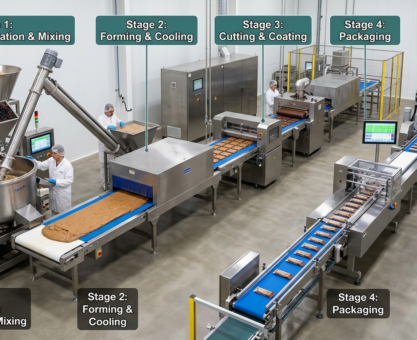
raw material quality → preparation → hydration and mixing → extrusion → die shaping → cutting → drying → cooling → quality control → packaging
This guide explains how defatted soy flour for soya chunks is selected and processed, how the soy flour extrusion process works, what can cause production problems, and what manufacturers should evaluate before investing in or modifying a TVP production system.
What Is Defatted Soy Flour?
Defatted soy flour is soybean material from which much of the oil has been removed, followed by milling into a flour or meal-like powder with a controlled particle size.
Soybeans naturally contain substantial amounts of oil as well as protein, carbohydrates, minerals, fiber, and other components. During conventional oil extraction, the beans may be processed into flakes or other intermediate materials, and the resulting defatted material can then be milled.
The exact composition of commercial defatted soy flour varies according to:
- soybean variety
- growing conditions
- oil extraction method
- degree of dehulling
- heat treatment
- milling conditions
- storage history
- moisture content
- analytical method used for composition testing
For TVP production, the most important consideration is not simply the label on the raw-material bag. The manufacturer needs a material whose composition and functional behavior are suitable for the intended extrusion process.
Why defatted soy flour is used for soya chunks
Defatted soy flour is attractive for textured products because soy contains proteins capable of forming a continuous structure under appropriate thermomechanical processing.
During extrusion:
- water hydrates the proteins and other components
- heat changes protein structure
- mechanical shear promotes mixing and structural transformation
- pressure develops inside the extruder
- the material is forced through a die
- pressure falls as the extrudate exits
- water can partially flash into vapor
- the expanding material develops a porous structure
The resulting product can have a fibrous or cellular texture that allows it to absorb water during later preparation.
The final structure depends on the interaction between raw-material properties and processing conditions.
Defatted Soy Flour vs. Soybean Flour
The terms soy flour, defatted soy flour, soybean flour, and soy protein ingredients are sometimes used loosely, but they do not describe identical materials.
Soybean flour
Soybean flour can refer broadly to milled soybean material. Depending on the product specification, it may retain a significant portion of the soybean’s natural oil.
Defatted soy flour
Defatted soy flour has undergone oil removal before or during the production of the flour. Its lower lipid content changes both its nutritional composition and its processing behavior.
Soy protein concentrate
Soy protein concentrate is a more protein-rich ingredient produced by additional processing of soy material. Its composition and functionality can differ substantially from ordinary defatted soy flour.
Soy protein isolate
Soy protein isolate is processed further to obtain a highly concentrated protein ingredient. It behaves differently from flour during extrusion and is often used for applications requiring specific protein functionality.
Practical implication
A manufacturer should never substitute one soy ingredient for another solely because all of them are described as “soy protein.”
Changes in ingredient type can affect:
- water demand
- melt behavior
- torque
- pressure
- expansion
- texture
- color
- bulk density
- drying behavior
- finished-product hydration
A formulation and extrusion setting that works with one material may require adjustment when another ingredient is introduced.
Why Defatted Soy Flour Matters in Soya Chunks Production
The quality of defatted soy flour for soya chunks directly influences process stability and finished-product performance.
The flour provides much of the protein matrix that becomes structured during extrusion. However, protein percentage alone does not tell the whole story.
A manufacturer should consider the following raw-material characteristics.
Protein content
Protein is central to the formation of the extruded structure.
Higher or lower protein content can alter:
- water requirements
- melt viscosity
- mechanical behavior
- expansion
- density
- texture
- nutritional composition
The appropriate specification depends on the intended product and formulation.
Residual fat
Defatting removes much of the soybean oil, but residual lipid can remain.
Fat can influence extrusion because it may:
- lubricate the material
- reduce mechanical friction
- affect shear
- modify melt viscosity
- influence expansion
- alter finished texture
This does not mean that lower residual fat is automatically better. The important point is consistency and compatibility with the process.
Moisture
Moisture is one of the most important variables in extrusion.
Too little available water can produce:
- excessive torque
- poor mixing
- unstable extrusion
- excessive mechanical stress
- burning or localized overheating
- dense or poorly developed structure
Excessive moisture can produce:
- reduced expansion
- softer extrudate
- altered die pressure
- increased drying requirements
- different final density
The correct moisture level is process-specific.
Particle size
Particle-size distribution affects hydration and melting behavior.
Very coarse particles may hydrate more slowly and create nonuniform processing. Extremely fine material can behave differently during feeding and may affect bulk density and conveying.
A controlled particle-size distribution can help improve:
- feeder consistency
- hydration
- mixing
- extrusion stability
- product uniformity
Heat history
Soy proteins are sensitive to thermal processing.
The previous heat treatment applied to the soy material can influence protein functionality and therefore extrusion behavior.
Two materials with similar proximate composition may behave differently if their thermal histories differ.
Fiber and carbohydrate composition
Soy flour contains components other than protein.
Carbohydrates and fiber can affect:
- water binding
- viscosity
- expansion
- cell formation
- firmness
- final texture
The formulation therefore needs to be evaluated as a complete system rather than through protein percentage alone.
Raw Material for TVP Production: What Should Manufacturers Check?
Selecting the raw material for TVP production should involve a documented specification rather than informal visual inspection.
A practical incoming-material specification may include:
- identity and source
- moisture
- protein
- fat
- ash
- fiber, where relevant
- particle-size distribution
- microbiological criteria
- sensory condition
- foreign-material control
- storage conditions
- lot identification
- relevant allergen information
- applicable food-safety requirements
The exact specification should be established according to the product, process, market, and applicable regulations.
A useful raw-material qualification procedure
Before approving a new supplier or material, manufacturers can use a staged evaluation.
- Review the supplier specification.
- Check declared composition.
- Confirm processing history where relevant.
- Review lot-to-lot consistency.
- Inspect representative samples.
- Examine appearance.
- Check odor.
- Assess signs of moisture damage or contamination.
- Perform laboratory testing.
- Confirm critical composition parameters.
- Test moisture and other relevant properties.
- Evaluate functionality.
- Run a controlled extrusion trial.
- Record torque, pressure, temperature, throughput, and product characteristics.
- Compare finished-product performance.
- Evaluate expansion.
- Measure density where required.
- Assess hydration.
- Examine texture and structural integrity.
- Approve or reject against predefined criteria.
This approach is more reliable than selecting flour solely according to a supplier’s protein number.
How the Soy Flour Extrusion Process Works
The soy flour extrusion process combines several operations inside a continuous system.
The basic sequence is:
feeding → conveying → mixing → hydration → heating → shearing → cooking → pressurization → die shaping → expansion → cutting
The extruder performs multiple functions at once.
1. Feeding
Defatted soy flour enters the extrusion system through a controlled feeding mechanism.
Stable feeding matters because fluctuations in mass flow can change:
- moisture-to-solid ratio
- residence time
- torque
- pressure
- product density
- die output
Bridging or inconsistent feeding can create visible fluctuations in the product.
Feeding considerations
Manufacturers should consider:
- bulk density
- flour flowability
- hopper design
- feeder accuracy
- screw speed
- material conditioning
- particle-size distribution
A good extrusion process cannot compensate indefinitely for an unstable feed system.
2. Conveying
The screw transports the flour through the barrel.
Different screw sections can perform different functions, including:
- conveying
- mixing
- compression
- kneading
- shearing
The exact screw configuration depends on the extruder design and product requirements.
A screw is therefore more than a simple transport device. Its geometry influences the mechanical and thermal history experienced by the material.
3. Hydration and Mixing
Water is introduced either before extrusion or within the extrusion system, depending on the process design.
The objective is to distribute moisture sufficiently throughout the material.
Uniform hydration supports more consistent cooking and structural development.
Poor hydration can cause:
- dry pockets
- unstable pressure
- inconsistent expansion
- hard particles
- nonuniform texture
Water quality can also matter because dissolved minerals and other characteristics may influence process behavior.
What Happens to Soy Protein During Extrusion?
One of the key scientific aspects of how soy chunks extruder systems work is protein transformation.
Soy proteins are originally present in relatively organized molecular structures within the raw material. Under extrusion conditions, the combination of heat, moisture, pressure, and mechanical shear changes protein structure.
Protein molecules can unfold and interact with one another.
The process may involve:
- disruption of native structures
- protein unfolding
- molecular rearrangement
- interaction between protein chains
- formation of a continuous matrix
As the material moves toward the die, this transformed matrix can become oriented by flow.
After exiting the die, pressure decreases rapidly. Water vaporization and cooling can contribute to the formation of pores and the final cellular structure.
The precise molecular mechanisms depend on formulation and processing conditions, so a simple description such as “heat creates texture” is incomplete.
The Role of Moisture in Soy Flour Extrusion
Moisture is a central process variable.
Water performs several functions inside the extruder:
- plasticizes the material
- assists heat transfer
- facilitates molecular mobility
- affects viscosity
- influences shear
- influences pressure
- affects expansion
- determines part of the drying load
A useful conceptual relationship is:
more water generally makes the material more plastic and less viscous, while lower moisture can increase resistance to flow.
However, this is not a universal linear rule. Other variables such as temperature, screw speed, formulation, and die geometry interact with moisture.
Moisture-related troubleshooting
If the product is too dense
Possible contributors include:
- excessive moisture
- insufficient die pressure
- inadequate cooking
- unsuitable screw configuration
- poor expansion conditions
- formulation differences
If the product expands excessively
Possible contributors include:
- insufficiently controlled moisture
- excessive pressure release
- unsuitable die geometry
- high melt temperature
- formulation characteristics
If the product becomes brittle
Possible contributors include:
- excessive drying
- inadequate structural development
- formulation imbalance
- excessive thermal exposure
- unsuitable extrusion conditions
The correct response should be based on process measurements rather than changing several settings simultaneously.
Temperature in the Soy Flour Extrusion Process
Temperature is another major variable, but the relevant temperature is not necessarily the same as the temperature shown at one point on the machine.
A process may involve:
- feed-zone temperature
- barrel-zone temperatures
- material temperature
- die temperature
- exit temperature
The actual product temperature can differ from the set temperature because mechanical energy generated by screw rotation contributes heat.
Why mechanical energy matters
The extruder converts some motor power into mechanical work on the material.
That energy can contribute to:
- mixing
- shear
- pressure generation
- heating
- structural transformation
Therefore, increasing screw speed can change product temperature even when barrel setpoints remain unchanged.
This is one reason extrusion should be treated as a coupled thermomechanical process.
Screw Speed and Shear
Screw speed influences residence time, mechanical energy input, throughput, mixing, and pressure development.
Increasing screw speed may:
- increase shear
- increase mechanical energy
- alter residence time
- affect melt temperature
- change pressure
- change expansion
But the result depends on the entire system.
A manufacturer should avoid assuming that higher screw speed automatically means higher production quality or higher output efficiency.
The relationship between speed and throughput depends on:
- screw design
- motor capacity
- material properties
- moisture
- die restriction
- feeder performance
- extruder size
Die Design and Soya Chunk Shape
The die controls the final geometry of the extrudate and strongly influences the pressure-release environment.
The die can affect:
- cross-sectional shape
- pressure
- flow distribution
- expansion
- surface appearance
- cutting behavior
- product dimensions
For soya chunks, the die should be considered together with the cutter and downstream dryer.
A change in die opening can alter the entire downstream process because different dimensions affect:
- surface-area-to-volume ratio
- drying rate
- bulk density
- hydration behavior
- packaging characteristics
Cutting the Extrudate
After leaving the die, the hot extrudate is cut into the desired shape.
Cutting conditions influence:
- particle length
- shape
- consistency
- fines
- product appearance
An improperly adjusted cutter can produce:
- excessive fines
- elongated pieces
- irregular pieces
- compressed ends
- inconsistent dimensions
The cutter should be evaluated together with die output and extrudate mechanical properties.
Expansion and Cellular Structure
The characteristic porous structure of many dry TVP products develops around the die-exit stage.
Inside the extruder, water exists under elevated pressure. When the product leaves the die, pressure drops.
Some water changes phase and contributes to expansion.
The resulting structure is affected by:
- moisture
- temperature
- pressure
- protein concentration
- carbohydrate composition
- shear
- die design
- cooling rate
Expansion is therefore a process outcome rather than an isolated machine setting.
From Extruder to Dryer
Freshly extruded soya chunks generally contain more moisture than the final packaged product should contain.
Drying therefore becomes a critical downstream operation.
A typical process is:
- Extrudate leaves the die.
- Product is cut.
- Product is conveyed to the dryer.
- Moisture is removed under controlled conditions.
- Product is cooled.
- Product is inspected.
- Product is packaged.
The dryer should be sized and operated according to the actual product load rather than only the nominal extruder capacity.
Drying Soya Chunks Correctly
Drying has two competing objectives:
- remove sufficient moisture for the required shelf stability and handling characteristics
- avoid excessive thermal or physical damage
Important drying variables include:
- inlet air conditions
- air velocity
- residence time
- product loading
- product size
- bed depth
- final moisture target
- ambient conditions
Large chunks and small granules do not necessarily require identical drying conditions.
Why over-drying can be a problem
Excessive drying can contribute to:
- brittle texture
- greater breakage
- increased fines
- unnecessary energy consumption
- changes in cooking behavior
Why under-drying can be a problem
Insufficient drying can contribute to:
- poor storage stability
- clumping
- undesirable microbial risk
- packaging problems
- inconsistent product weight
The appropriate moisture specification should be established through product validation and applicable food-safety requirements.
Cooling Before Packaging
After drying, the product should generally be cooled sufficiently for the packaging operation.
Packaging warm product can create moisture migration and condensation issues if the product and surrounding air are not properly controlled.
Cooling also helps stabilize the product before packaging.
Manufacturers should monitor:
- product temperature
- environmental humidity
- residence time
- final moisture
- packaging-room conditions
Quality Control for Defatted Soy Flour and Soya Chunks
A robust quality-control system should cover both incoming material and finished product.
Raw-material checks
Depending on the product specification, checks may include:
- moisture
- protein
- fat
- ash
- fiber
- particle size
- microbiological quality
- sensory characteristics
- foreign material
- allergen controls
In-process checks
Useful process measurements include:
- feed rate
- water addition
- moisture ratio
- screw speed
- motor load
- torque
- barrel temperatures
- product temperature
- die pressure
- throughput
- cutter performance
Finished-product checks
Depending on the intended application:
- moisture
- bulk density
- particle dimensions
- expansion
- appearance
- color
- texture
- hydration behavior
- cooking performance
- fines percentage
- microbiological quality
- packaging integrity
The most useful QC program links process variables to finished-product attributes.
Bulk Density and Why It Matters
Bulk density describes the mass of product occupying a given bulk volume.
It can influence:
- packaging volume
- transport efficiency
- appearance
- consumer perception
- hydration characteristics
- formulation calculations
A product with unexpectedly high bulk density may indicate inadequate expansion or structural differences.
However, bulk density should not be interpreted alone. A product can have an acceptable density and still fail texture or hydration requirements.
Hydration Performance of Soya Chunks
One reason consumers use dry soya chunks is their ability to absorb water during preparation.
Hydration behavior can depend on:
- pore structure
- cell connectivity
- protein structure
- density
- particle dimensions
- drying conditions
- formulation
Testing should therefore reflect the intended consumer preparation method.
Useful measurements may include:
- water absorption
- hydration time
- hydrated mass
- dimensional change
- texture after hydration
- water retention after cooking
A laboratory hydration test should use controlled conditions so that different production lots can be compared meaningfully.
Texture Development in the Soy Chunks Extruder Process
Texture is created by the combined effects of raw material and extrusion.
Important factors include:
- protein concentration
- protein functionality
- moisture
- thermal history
- mechanical energy
- die conditions
- expansion
- drying
Weak texture may be associated with:
- unsuitable raw material
- excessive or insufficient moisture
- inadequate protein functionality
- unsuitable processing conditions
- poor expansion
- excessive drying
- mechanical damage after extrusion
Excessively hard texture may be associated with:
- low moisture during processing
- high density
- inadequate hydration of the feed
- unsuitable thermal conditions
- structural characteristics of the formulation
Troubleshooting should start by identifying whether the problem originated before, inside, or after the extruder.
Defatted Soy Flour for Soya Chunks: Supplier Selection
A supplier should be evaluated based on consistency and suitability rather than price alone.
Useful supplier-selection criteria include:
- clearly defined material specification
- traceable lot identification
- consistent composition
- reliable delivery
- appropriate packaging
- storage recommendations
- documented quality controls
- ability to provide representative samples
- willingness to support technical evaluation
- change-notification procedures
A low-cost ingredient can become expensive if it produces unstable extrusion and high levels of off-specification product.
Questions to ask a raw-material supplier
Before purchasing defatted soy flour for soya chunks, manufacturers can ask:
- What is the typical composition range?
- How is the material processed?
- What is the expected moisture range?
- How consistent is particle size?
- How is heat treatment controlled?
- What storage conditions are recommended?
- How are lots identified?
- What testing accompanies each shipment?
- What happens if the raw material specification changes?
- Can samples be provided for extrusion trials?
The purpose is to understand the material as a process input rather than merely as a commodity.
Storage of Defatted Soy Flour
Storage conditions can affect raw-material quality.
Important considerations include:
- moisture control
- temperature
- pest prevention
- contamination prevention
- packaging integrity
- stock rotation
- traceability
- exposure to odors
- protection from excessive humidity
Because soy flour is a food ingredient, storage practices should be aligned with the facility’s food-safety system and applicable requirements.
Signs that stored flour requires investigation
- unusual odor
- visible moisture damage
- caking
- discoloration
- damaged packaging
- pest activity
- unexplained extrusion changes
A raw material that has changed during storage should not simply be fed into production because the supplier specification was originally acceptable.
Common Mistakes in Soy Flour Extrusion
Mistake 1: Selecting flour only by protein percentage
Protein percentage is important, but it does not fully describe functional performance.
Better approach: evaluate composition alongside extrusion trials and finished-product testing.
Mistake 2: Changing several process variables simultaneously
Changing moisture, screw speed, temperature, and die conditions at the same time makes troubleshooting difficult.
Better approach: use controlled trials and change one major variable at a time where practical.
Mistake 3: Ignoring feed stability
An unstable feeder can create downstream process variation that appears to be an extruder problem.
Better approach: verify feed rate before modifying the screw profile.
Mistake 4: Treating barrel temperature as actual product temperature
Mechanical energy can significantly affect material temperature.
Better approach: monitor product temperature where appropriate.
Mistake 5: Assuming maximum throughput is the best operating point
Increasing throughput can affect residence time, mixing, die pressure, drying load, and product quality.
Better approach: define an operating window based on both productivity and quality.
Mistake 6: Using the same drying conditions for every product size
Different shapes and dimensions dry differently.
Better approach: validate drying conditions for each significant product format.
Mistake 7: Ignoring downstream handling
A good extrudate can become a poor finished product if it is damaged during conveying, drying, cooling, or packaging.
Better approach: evaluate the entire production chain.
Troubleshooting a Soya Chunks Extrusion Line
When production becomes unstable, troubleshooting should follow the process sequence.
Problem: Extruder pressure fluctuates
Investigate:
- inconsistent feed rate
- moisture variation
- particle-size variation
- feeder bridging
- screw wear
- die blockage
- raw-material changes
Problem: Product density increases
Investigate:
- moisture
- die pressure
- product temperature
- screw speed
- formulation
- expansion conditions
- raw-material changes
Problem: Product contains excessive fines
Investigate:
- cutter condition
- extrudate brittleness
- drying intensity
- conveying damage
- product moisture
- die condition
Problem: Product color changes between lots
Investigate:
- raw-material color
- heat history
- thermal exposure
- residence time
- formulation
- drying conditions
Problem: Hydration performance declines
Investigate:
- bulk density
- pore structure
- extrusion conditions
- drying conditions
- raw-material functionality
- storage conditions
The goal is to identify the process variable most closely associated with the change instead of adjusting the machine randomly.
How to Improve the Soy Flour Extrusion Process
Process improvement should begin with measurement.
A useful improvement program can follow this sequence:
- Define the finished-product specification.
- Identify the critical quality attributes.
- Define raw-material specifications.
- Record extrusion operating conditions.
- Establish a baseline production run.
- Identify major sources of variation.
- Run controlled trials.
- Compare product and process data.
- Define acceptable operating ranges.
- Document the validated process.
- Train operators against the documented procedure.
- Monitor ongoing production for drift.
This approach turns extrusion from operator-dependent adjustment into a more controlled manufacturing process.
Critical Process Variables and Quality Attributes
A useful process-control matrix can connect inputs to outcomes.
|
Process area |
Variable |
Potential effect |
|
Raw material |
Moisture |
Flow, viscosity, expansion, drying |
|
Raw material |
Protein |
Structure and texture |
|
Raw material |
Particle size |
Feeding and hydration |
|
Raw material |
Residual fat |
Lubrication and flow |
|
Feeding |
Feed rate |
Throughput and residence time |
|
Extruder |
Screw speed |
Shear, energy, residence time |
|
Extruder |
Moisture addition |
Plasticization and expansion |
|
Extruder |
Temperature |
Cooking and material properties |
|
Extruder |
Die restriction |
Pressure and shape |
|
Cutting |
Cutter speed |
Piece size and fines |
|
Drying |
Air conditions |
Final moisture |
|
Cooling |
Product temperature |
Packaging stability |
The exact relationships should be confirmed experimentally for each production system.
Equipment Considerations for TVP Production
A commercial line may contain several interconnected equipment sections.
Depending on the design, these can include:
- raw-material storage
- flour handling
- weighing or dosing
- mixing
- water dosing
- preconditioning
- extrusion
- die assembly
- cutting
- conveying
- drying
- cooling
- screening
- metal detection or other safety controls
- packaging
The raw material for TVP production should be considered during equipment selection because material characteristics influence handling and extrusion.
Extruder selection criteria
Important considerations include:
- desired throughput
- product format
- formulation
- moisture range
- required cooking intensity
- die requirements
- screw configuration
- motor capacity
- control system
- cleaning requirements
- maintenance access
- downstream drying capacity
A machine should be selected according to the intended process rather than capacity alone.
Single-Screw vs. Twin-Screw Extrusion
Extruder architecture can influence process flexibility.
Single-screw systems
Single-screw extruders can provide relatively straightforward continuous processing and may be suitable for formulations that are already well controlled.
Potential advantages include:
- simpler mechanical arrangement
- established operating principles
- potentially lower mechanical complexity
Twin-screw systems
Twin-screw systems can provide additional flexibility in:
- mixing
- feeding
- shear management
- ingredient incorporation
- process control
The best configuration depends on formulation, product specifications, throughput requirements, and process objectives.
A machine comparison should therefore evaluate the complete process rather than treating screw count as the deciding factor.
Pilot Trials Before Commercial Production
Pilot extrusion trials can reduce uncertainty when a new formulation, raw material, or machine is being considered.
A meaningful trial should record:
- raw-material lot
- formulation
- moisture addition
- feed rate
- screw speed
- temperature settings
- product temperature
- pressure
- motor load or torque
- die configuration
- cutter settings
- drying conditions
- final moisture
- bulk density
- hydration performance
- texture observations
A trial is much more valuable when the results are documented quantitatively.
When Specialized Process Expertise Is Useful
Some projects can be managed through normal plant engineering and operator experience. Others benefit from specialized technical support.
Professional process or engineering assistance may be particularly useful when:
- a new TVP product is being developed
- a new raw-material supplier is being qualified
- extrusion is unstable despite normal adjustments
- the production line is being scaled
- a new extruder is being selected
- multiple product formats must run on one system
- energy consumption needs systematic evaluation
- laboratory results do not translate to commercial production
- repeated batches fall outside specification
Specialized support can involve:
- formulation evaluation
- raw-material characterization
- extrusion trials
- process mapping
- equipment sizing
- screw and die evaluation
- drying calculations
- quality-system development
- validation planning
The purpose is to reduce uncertainty and establish reproducible operating conditions.
Process Validation for Commercial Soya Chunks
Validation is particularly important when moving from development to routine production.
A validation program can examine:
- raw-material consistency
- critical process variables
- finished-product quality
- process capability
- equipment performance
- repeatability across production runs
A documented validation protocol should define:
- what will be tested
- how samples will be collected
- what measurements will be made
- acceptance criteria
- corrective actions
- documentation requirements
The exact validation approach depends on the product and regulatory environment.
Food Safety and Compliance Considerations
Soy-based products are food products, so food safety must be integrated into raw-material handling, extrusion, drying, storage, and packaging.
Depending on the market and product, manufacturers may need to consider:
- allergen management
- microbiological controls
- supplier approval
- sanitation
- traceability
- foreign-material control
- labeling requirements
- applicable food regulations
- environmental and occupational controls
Regulatory requirements vary by country and product category. Manufacturers should verify current requirements with the relevant competent authority or qualified regulatory professional rather than relying on generic internet summaries.
Economics of Defatted Soy Flour to Soya Chunks Production
The economics of TVP manufacturing extend beyond the purchase price of flour.
Major cost factors can include:
- raw material
- water
- electricity
- thermal energy
- labor
- maintenance
- spare parts
- packaging
- quality testing
- cleaning and sanitation
- product losses
- fines
- downtime
- depreciation or financing
- waste management
Why raw-material consistency affects cost
Suppose a material has variable moisture or functional behavior. The manufacturer may need frequent process adjustments.
That can increase:
- startup losses
- off-specification product
- downtime
- operator intervention
- energy consumption
- testing requirements
A slightly more expensive but more consistent raw material may therefore perform better economically than an inexpensive material that creates repeated process instability.
Capacity Planning for a TVP Line
A production-line capacity calculation should distinguish between theoretical machine throughput and practical output.
Practical output is influenced by:
- operating hours
- startup and shutdown
- cleaning
- changeovers
- maintenance
- raw-material availability
- dryer capacity
- packaging capacity
- quality holds
- product losses
The extrusion section should not be considered independently.
For example, an extruder capable of producing a certain mass flow may create a bottleneck downstream if the dryer cannot remove moisture at the required rate.
Capacity planning should therefore consider the complete line.
Energy Considerations
Energy consumption can arise from:
- extrusion motor power
- heating systems
- drying
- cooling
- compressed air
- conveying
- packaging
- ancillary equipment
Drying is often an important energy-consuming stage because water must be removed from the extrudate.
Process optimization can therefore involve reducing unnecessary moisture movement through the line while maintaining product quality.
However, lowering energy consumption should not be pursued by compromising validated product characteristics.
Maintenance Considerations
Extrusion equipment operates under significant mechanical and thermal conditions.
Maintenance planning should cover:
- screw components
- barrel sections
- bearings
- seals
- gearbox
- motor
- feeder
- water system
- temperature sensors
- pressure sensors
- die assembly
- cutter
- conveyors
- dryer components
Signs of possible mechanical problems
- unexpected vibration
- abnormal noise
- unexplained motor-load changes
- unstable pressure
- declining throughput
- leakage
- repeated die blockage
- unusual wear particles
Maintenance should be preventive where practical rather than waiting for a major failure.
Cleaning and Hygiene
Food-processing equipment needs an appropriate cleaning strategy.
Extrusion systems can contain areas where material accumulates, especially around:
- feed points
- transition zones
- die assemblies
- cutter areas
- conveyors
- dryer surfaces
- product-contact components
The cleaning method should be compatible with the equipment design and the manufacturer’s maintenance instructions.
Sanitation procedures should also account for allergen control when multiple products are processed in the same facility.
How to Select Defatted Soy Flour for Soya Chunks
A practical selection checklist is:
Raw-material checklist
- Defined protein specification
- Defined moisture specification
- Controlled residual fat
- Suitable particle-size distribution
- Acceptable sensory quality
- Appropriate microbiological specification
- Traceable lots
- Reliable packaging
- Stable supplier quality
- Successful extrusion trial
- Acceptable finished-product texture
- Acceptable hydration performance
The final decision should be based on demonstrated suitability rather than a specification sheet alone.
A Practical Soy Flour Extrusion Trial Plan
When evaluating a new soy flour extrusion process, a controlled trial can follow this structure.
Stage 1: Raw-material characterization
Record:
- composition
- moisture
- particle size
- appearance
- storage history
- supplier lot
Stage 2: Baseline extrusion
Use a known process configuration.
Record:
- feed rate
- water addition
- screw speed
- temperature
- torque
- pressure
- throughput
- product temperature
Stage 3: Product evaluation
Measure:
- moisture
- bulk density
- expansion
- dimensions
- fines
- hydration
- texture
Stage 4: Controlled optimization
Adjust selected process variables systematically.
Avoid changing everything at once.
Stage 5: Repeatability test
Repeat the preferred condition using additional material or production runs.
The objective is to determine whether the process remains stable rather than simply obtaining one good sample.
How to Diagnose Raw-Material Problems vs. Machine Problems
This distinction can save considerable troubleshooting time.
A raw-material problem is more likely when:
- the machine is stable but product quality changes by lot
- laboratory composition changes
- moisture varies between deliveries
- extrusion behavior changes after supplier changes
- multiple production settings suddenly require adjustment
A machine or process problem is more likely when:
- the same material behaves differently over time
- pressure fluctuates continuously
- mechanical load changes without a raw-material change
- die blockage occurs repeatedly
- cutter performance deteriorates
- temperature control becomes unstable
Both can occur simultaneously, so the best diagnosis uses production records and laboratory data together.
Why Production Records Matter
A production record can turn troubleshooting from guesswork into evidence-based analysis.
Useful records include:
- raw-material lot
- supplier
- formulation
- production date
- operator
- feed rate
- water addition
- screw speed
- temperature
- pressure
- torque
- throughput
- dryer conditions
- final moisture
- product QC results
- downtime
- corrective actions
Over time, these records can reveal relationships between raw-material changes and process behavior.
Common Misconceptions About Defatted Soy Flour
“All defatted soy flour behaves the same.”
It does not. Composition and processing history can differ between materials.
“More protein always gives better chunks.”
Not necessarily. Protein concentration matters, but protein functionality, moisture, formulation, and processing conditions also influence structure.
“Higher extrusion temperature always improves texture.”
Temperature must be considered alongside moisture, shear, residence time, and pressure.
“The extruder determines the entire product quality.”
Product quality depends on the full chain from raw material through packaging.
“A laboratory result is enough to approve a new flour.”
Laboratory composition is important, but extrusion functionality should also be demonstrated.
“Drying is just a final utility step.”
Drying can materially influence texture, breakage, moisture, storage stability, and energy consumption.
Step-by-Step Commercial Production Workflow
For a typical dry TVP or soya chunk process based primarily on soy flour, the workflow can be summarized as follows.
- Receive the raw material.
- Verify supplier, lot, packaging, and specification.
- Inspect and test the defatted soy flour.
- Confirm relevant quality parameters.
- Store under controlled conditions.
- Protect against moisture, pests, contamination, and excessive environmental exposure.
- Dose the flour.
- Maintain accurate and consistent feeding.
- Add water and other permitted formulation ingredients as required.
- Achieve controlled moisture distribution.
- Feed the extruder.
- Maintain stable mass flow.
- Convey and mix.
- Distribute ingredients and water.
- Apply controlled heat and mechanical energy.
- Develop the desired thermomechanical transformation.
- Build pressure before the die.
- Establish suitable flow and shaping conditions.
- Extrude through the die.
- Create the desired geometry.
- Cut the extrudate.
- Control piece dimensions and minimize fines.
- Dry the product.
- Remove moisture to the validated target.
- Cool the product.
- Stabilize it before packaging.
- Inspect and test.
- Confirm finished-product specifications.
- Package and store.
- Protect product quality throughout distribution.
This sequence provides the framework, but actual operating parameters must be established for the specific formulation, equipment, and product specification.
FAQs About Defatted Soy Flour and Soya Chunks
Question: What is defatted soy flour?
Answer: Defatted soy flour is milled soybean material from which much of the natural oil has been removed. It contains soy protein along with carbohydrates, fiber, minerals, residual lipid, and other soybean components.
Question: Why is defatted soy flour used for soya chunks?
Answer: It provides soy protein and other solids that can undergo thermomechanical transformation during extrusion. Under suitable moisture, heat, shear, pressure, and die conditions, the material can form a porous structured product.
Question: Is defatted soy flour the same as soy protein isolate?
Answer: No. Soy protein isolate is processed further and has a substantially different composition and functionality. It should not automatically be substituted for defatted soy flour in an existing extrusion process.
Question: What is the raw material for TVP production?
Answer: TVP can be produced from different protein-containing ingredients, including soy-based ingredients. The appropriate raw material depends on the desired nutritional composition, texture, formulation, processing system, and finished-product specification.
Question: What is the soy flour extrusion process?
Answer: The soy flour extrusion process typically involves controlled feeding, hydration, conveying, mixing, heating, mechanical shearing, cooking, pressurization, die shaping, expansion, cutting, and downstream drying.
Question: How does a soy chunks extruder create texture?
Answer: The extruder subjects hydrated soy material to heat, pressure, and mechanical shear. Protein structures change and form a continuous matrix. Flow through the die and pressure release at the outlet contribute to the porous structure characteristic of many dry textured soy products.
Question: Does protein percentage determine soya chunk quality?
Answer: No. Protein content is important, but protein functionality, moisture, residual fat, particle size, thermal history, formulation, extrusion conditions, die design, and drying can all affect the final product.
Question: How does moisture affect soy flour extrusion?
Answer: Moisture plasticizes the material and influences viscosity, heat transfer, mechanical energy, pressure, expansion, and drying requirements. Too little or too much moisture can create different process and quality problems.
Question: Why does soya chunk density change?
Answer: Density can change because of differences in raw material, moisture, temperature, shear, pressure, die conditions, expansion, and drying. Density should be assessed alongside texture and hydration rather than as an isolated measurement.
Question: Why are my soya chunks too hard?
Answer: Possible causes include inadequate hydration, unsuitable extrusion conditions, excessive density, changes in raw-material functionality, or inappropriate drying. Process records and controlled trials are needed to identify the actual cause.
Question: Why are soya chunks brittle after drying?
Answer: Excessive drying, structural weakness, formulation changes, or mechanical damage can contribute to brittleness. The appropriate response depends on where the change occurs in the process.
Question: Why do extruded soya chunks have excessive fines?
Answer: Fines can result from cutter problems, brittle extrudate, unsuitable drying, excessive mechanical handling, die conditions, or raw-material changes. Inspection should cover both cutting and downstream handling.
Question: Can different suppliers’ defatted soy flour be used interchangeably?
Answer: Not automatically. Materials with similar declared composition can still behave differently during extrusion. A supplier change should ideally be evaluated through laboratory testing and controlled extrusion trials.
Question: What should I test when buying defatted soy flour for soya chunks?
Answer: Relevant checks may include moisture, protein, fat, ash, fiber, particle size, microbiological quality, sensory condition, traceability, and demonstrated extrusion performance. The exact specification should match the product and applicable requirements.
Question: Does particle size matter in soy flour extrusion?
Answer: Yes. Particle size can influence feeding, hydration, mixing, and extrusion stability. A controlled particle-size distribution can help improve consistency.
Question: Does residual fat affect the soy flour extrusion process?
Answer: Yes. Residual lipid can influence lubrication, friction, viscosity, mechanical energy, and expansion. Consistency is important because a change in residual fat can alter processing behavior.
Question: What equipment is required for TVP production?
Answer: A typical system may include raw-material handling, dosing, mixing or conditioning, extrusion, die and cutting equipment, conveying, drying, cooling, screening, safety controls, and packaging. The exact equipment depends on product and capacity requirements.
Question: Is a twin-screw extruder always better for soya chunks?
Answer: No. Twin-screw and single-screw systems have different characteristics and process capabilities. The appropriate system depends on formulation, product specifications, throughput, process flexibility, and equipment design.
Question: How should a new soy flour be tested before commercial production?
Answer: Characterize the material, run a controlled baseline extrusion trial, record process variables, test the finished product, optimize selected variables systematically, and repeat the preferred condition to verify consistency.
Question: How can extrusion problems be diagnosed?
Answer: Start with the raw-material lot and feeding system, then examine moisture, screw speed, temperature, torque, pressure, die condition, cutter performance, drying, and finished-product results. Changing one major variable at a time can make cause-and-effect easier to identify.
Question: Does the extruder’s rated capacity equal actual production capacity?
Answer: Not necessarily. Practical output also depends on raw material, formulation, operating conditions, changeovers, downtime, drying capacity, packaging capacity, and product losses.
Question: What determines the cost of a soya chunks production line?
Answer: Cost depends on the required capacity, degree of automation, extrusion equipment, drying system, raw-material handling, utilities, packaging, building requirements, controls, installation, maintenance provisions, and other project-specific factors. A meaningful cost estimate requires a defined process scope rather than a machine name alone.
Question: Is drying important for final soya chunk quality?
Answer: Yes. Drying influences final moisture, texture, brittleness, storage stability, breakage, and energy use. Drying conditions should be validated for the product dimensions and formulation.
Question: How should defatted soy flour be stored?
Answer: It should be protected from excessive moisture, contamination, pests, packaging damage, and unsuitable environmental conditions. Storage practices should follow the ingredient supplier’s instructions and the facility’s food-safety system.
Question: Can soya chunks be made from ingredients other than defatted soy flour?
Answer: Yes. TVP can be produced from different plant-protein ingredients and blends. However, changing the principal ingredient can substantially alter hydration, extrusion behavior, texture, density, and nutritional composition.
Question: Why does changing the raw material require extrusion adjustment?
Answer: Ingredients can differ in protein functionality, moisture, particle size, fat, fiber, carbohydrate composition, and thermal history. These differences affect how the material responds to heat, water, shear, and pressure.
Question: What is the most important variable in the soy flour extrusion process?
Answer: There is no single universal variable. Product quality results from interactions among raw-material properties, moisture, temperature, mechanical energy, residence time, die conditions, and downstream drying.
Question: How can a manufacturer improve consistency in soya chunks production?
Answer: Use defined raw-material specifications, controlled feeding, documented process conditions, in-process measurements, finished-product testing, preventive maintenance, controlled drying, and systematic troubleshooting.
Question: When is professional extrusion support useful?
Answer: Specialized support can be valuable during new product development, scale-up, equipment selection, persistent troubleshooting, supplier qualification, process validation, or major line modifications. The need depends on the complexity and risk of the project.
Final Takeaway
Defatted soy flour is a critical starting point for many soya chunk and TVP applications, but raw-material quality alone does not determine the finished product. The material must be compatible with the extrusion system, moisture must be controlled, thermomechanical processing must be stable, the die and cutter must produce the required geometry, and drying must bring the product to its validated final condition without damaging its structure.
The most reliable approach is to control the entire chain:
consistent defatted soy flour → controlled formulation → stable feeding → uniform hydration → controlled extrusion → suitable die expansion → accurate cutting → validated drying → cooling → quality testing → protected packaging
For manufacturers, the most useful mindset is to treat the flour, extruder, dryer, and finished product as one interconnected process.
When selecting defatted soy flour for soya chunks, evaluate functionality rather than composition alone. When optimizing the soy flour extrusion process, record process variables rather than relying on operator observation. When selecting the raw material for TVP production, qualify suppliers through both laboratory data and production trials.
That approach reduces avoidable variation and makes it easier to identify whether a quality problem originates in the raw material, extrusion conditions, equipment, or downstream processing.