

An energy bar can look simple on a retail shelf, but producing thousands of consistent bars every hour requires much more than a mixer and a cutting machine. A commercial line must handle ingredient preparation, blending, forming, cooling, cutting, inspection, packaging, and sanitation while keeping texture, weight, dimensions, moisture, and appearance within defined limits.
That is where an energy bar production line becomes important.
The challenge for a manufacturer is rarely finding a machine that can perform one individual operation. The harder task is designing an integrated production system in which every machine works at the correct speed and with the right material characteristics. A formulation that works in a laboratory mixer may behave very differently when transferred to continuous commercial production.
The choice of energy bar manufacturing equipment therefore needs to be based on the product formulation, target output, bar dimensions, ingredient characteristics, packaging format, available factory space, labour model, sanitation requirements, and future production plans.
This guide explains how an energy bar production line works, what machines are commonly required, how capacity is determined, how factory layout affects efficiency, and which technical decisions deserve the most attention before equipment is purchased.
What Is an Energy Bar Production Line?
An energy bar production line is an integrated sequence of machines and processing stations used to manufacture energy bars from prepared ingredients through finished packaging.
Depending on the product, an energy bar production line may include:
- Ingredient storage and handling systems
- Weighing and batching equipment
- Dry ingredient mixers
- Syrup or binder preparation equipment
- Heating and temperature-control systems
- Main mixing equipment
- Slab forming or bar extrusion equipment
- Compression or rolling systems
- Cooling equipment
- Longitudinal and cross-cutting machines
- Bar handling conveyors
- Metal detection or other inspection equipment
- Primary packaging machinery
- Secondary packing equipment
- Date and batch coding systems
- Cleaning and sanitation infrastructure
The exact configuration varies considerably.
An energy bar containing nuts, oats, seeds, crisped grains, dried fruit, protein powders, and a cooked syrup binder requires different processing conditions from a soft fruit-based bar or a high-protein bar.
The energy bar production equipment must therefore be selected around the formulation rather than simply around a desired production rate.
How Does an Energy Bar Production Line Work?
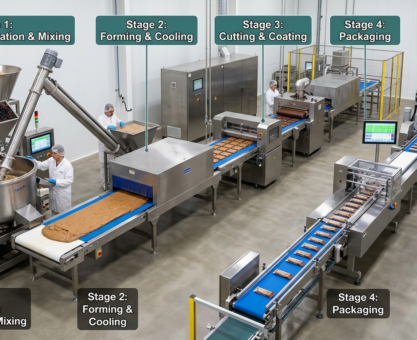
At a basic level, commercial energy bar production follows a controlled sequence:
- Raw materials are received and inspected.
- Ingredients are stored under appropriate conditions.
- Ingredients are weighed or dosed according to the formulation.
- Dry components are prepared and mixed.
- Binder components are prepared when required.
- Ingredients are combined under controlled mixing conditions.
- The finished mass is transferred to the forming system.
- The mass is formed into a slab, rope, sheet, or directly shaped bars.
- The formed product is cooled or conditioned.
- Bars are cut to the required dimensions.
- Finished bars are inspected.
- Bars are individually wrapped.
- Packaged products are coded and checked.
- Finished goods are packed into cartons or cases.
- Products are moved into finished-goods storage.
This sequence represents the foundation of an energy bar making process, but commercial systems can be considerably more sophisticated.
Some manufacturers use batch processing, while others use partially or highly automated systems. The appropriate design depends on product characteristics, required capacity, investment level, and operational strategy.
Main Machines in an Energy Bar Production Line
The machine configuration is one of the most important decisions in commercial production. Each piece of energy bar manufacturing equipment should have a defined role and should integrate with the machines before and after it.
A typical line can be divided into several functional sections.
-
Raw Material Handling Equipment
The production process begins before ingredients enter the mixer. Common raw materials include:
- Oats
- Cereals
- Nuts
- Seeds
- Dried fruits
- Protein ingredients
- Sweeteners
- Syrups
- Nut or seed butters
- Fats and oils
- Flavoring ingredients
- Salt
- Functional ingredients
- Coatings or inclusions
Raw materials may arrive in bags, boxes, drums, totes, or other containers. The factory therefore needs a controlled method for moving ingredients from receiving to production.
Typical handling equipment
Depending on the factory, this can include:
- Ingredient bins
- Storage hoppers
- Bag-dumping stations
- Conveyors
- Screw conveyors
- Pneumatic conveying systems
- Lifting equipment
- Weighing stations
- Ingredient dosing systems
The selection depends heavily on ingredient properties. Powders can behave differently from flakes. Whole nuts behave differently from sticky dried fruit. Syrups require completely different handling from dry cereals.
An energy bar production line should account for these differences from the beginning.
-
Weighing and Batching Systems
Ingredient accuracy directly affects product consistency.
A formulation may specify ingredients by weight, and the manufacturing process must reproduce those proportions consistently from batch to batch.
Manual weighing can be appropriate for smaller operations, speciality products, or low-volume ingredients. Automated dosing becomes more attractive as production volume and formulation complexity increase.
Important considerations include:
- Required weighing accuracy
- Batch size
- Number of ingredients
- Ingredient density
- Powder flow characteristics
- Dust generation
- Frequency of formulation changes
- Traceability requirements
- Labor availability
An automated energy bar production equipment configuration can use separate dosing systems for major and minor ingredients.
The objective is not simply automation for its own sake. The objective is controlled and repeatable ingredient addition.
-
Dry Ingredient Mixer
Many energy bar formulations begin with a dry blend. The mixer may combine ingredients such as:
- Oats
- Cereal pieces
- Seeds
- Nuts
- Protein powders
- Flakes
- Salt
- Dry flavors
Mixer selection depends on the physical characteristics of the ingredients. A fragile inclusion can be damaged by aggressive mixing. A powder may require sufficient agitation to distribute evenly. Large inclusions may need a different mixer geometry from fine powders.
-
Common mixer considerations
When selecting an energy bar manufacturing equipment system, evaluate:
- Mixing volume
- Working capacity
- Mixing time
- Agitation intensity
- Product fragility
- Discharge method
- Cleaning access
- Batch-to-batch consistency
- Ability to handle sticky materials
Overmixing can be just as problematic as undermixing. Excessive mechanical action can damage inclusions or alter the final texture. Insufficient mixing can create areas with inconsistent binder or functional ingredients.
-
Binder Preparation System
Many energy bars depend on a binder to hold dry ingredients together. Common binder components can include:
- Syrups
- Sugars
- Nut butters
- Seed butters
- Fats
- Other viscous ingredients
The binder may require heating or controlled temperature management before mixing. The precise processing conditions depend on the formulation. A binder that is too cold may become difficult to distribute. A binder that is excessively hot can affect ingredient texture and moisture behaviour.
A commercial energy bar making process therefore needs temperature control rather than simply heating ingredients until they appear liquid.
-
Binder system considerations
A binder preparation system may require:
- Heated vessels
- Agitators
- Temperature measurement
- Pumping equipment
- Insulated transfer lines
- Controlled discharge
- Cleaning provisions
The design should also consider how quickly the binder must reach the main mixer.
A delay between binder preparation and mixing can change viscosity and therefore alter the behaviour of the entire energy bar production line.
-
Main Mixing System
The main mixer combines the dry ingredients with the binder. This is often one of the most critical stages in commercial energy bar production.
The mixer must produce a mass with sufficient cohesion for forming while maintaining the intended distribution and texture of inclusions.
Important variables can include:
- Ingredient temperature
- Binder temperature
- Mixing time
- Mixing speed
- Addition sequence
- Batch size
- Binder viscosity
- Moisture distribution
- Product temperature after mixing
The addition sequence can matter considerably. For example, adding a viscous binder too rapidly can create localised high-binder areas. Adding fragile inclusions too early can expose them to unnecessary mechanical stress.
The correct sequence should therefore be established during product development and validated at production scale.
-
Forming Equipment
Once the mixture reaches the correct processing condition, it must be converted into a controlled shape. Several forming approaches are possible.
-
Slab forming
The mixture is deposited onto a conveyor or forming surface and converted into a continuous slab.
The slab can then be:
- Flattened
- Compressed
- Rolled
- Calibrated
- Cooled
- Cut into bars
Slab forming is useful for products that can maintain their structure during sheet formation.
b) Extrusion
Some formulations can be pushed through a forming die to create a continuous rope or profile.
Extrusion may offer advantages when the product has sufficient cohesion and suitable flow characteristics.
c) Compression forming
Compression can be used where pressure is necessary to produce a cohesive bar structure. The required forming method depends on the physical behaviour of the product.
There is no universal automatic energy bar line configuration that works equally well for every formulation.
7. Slab Former and Calibrating System
In a slab-based energy bar production line, the forming section determines the thickness and consistency of the product.
A typical sequence may involve:
- Product deposition
- Initial compression
- Rolling
- Thickness calibration
- Edge control
- Transfer to cooling
Thickness consistency is important because it influences:
- Final bar weight
- Cutting accuracy
- Appearance
- Cooling behavior
- Packaging performance
If slab thickness fluctuates, the downstream cutting system cannot completely compensate for the variation.
This is an important example of why production lines must be considered as interconnected systems.
8. Cooling System
Cooling is often essential before cutting and packaging. The purpose is to bring the formed product into a condition where it can be handled without excessive deformation, sticking, crumbling, or smearing.
Cooling requirements depend on:
- Product formulation
- Fat content
- Binder characteristics
- Moisture
- Product thickness
- Ambient conditions
- Desired texture
- Packaging requirements
A cooling conveyor or controlled cooling tunnel may be integrated into an energy bar production equipment system.
The objective is controlled conditioning rather than simply reducing product temperature as much as possible.
Excessive or uneven cooling can also create problems.
9. Cutting Machine
Once the slab or continuous product has reached the appropriate condition, it is cut into individual bars.
Cutting can involve:
- Longitudinal cutting
- Cross-cutting
- Guillotine cutting
- Rotary cutting
- Wire cutting
- Other product-specific mechanisms
The correct cutting system depends on product texture and geometry. A very soft product may deform under cutting pressure. A brittle product may fracture. A sticky product may adhere to cutting surfaces.
Therefore, cutting equipment should be tested using the actual formulation rather than a visually similar product.
10. Conveyors and Product Transfer
Conveyors connect the individual machines in the energy bar production line.
Their design affects:
- Product orientation
- Transfer stability
- Line speed
- Accumulation
- Hygiene
- Cleaning
- Product damage
- Floor-space requirements
Poor transfer design can create bottlenecks even when individual machines have adequate capacity.
For example, a forming machine may operate continuously while the packaging machine requires a different product spacing. An accumulation or synchronisation system may therefore be required.
11. Inspection Equipment
Quality control should not be treated as a final-stage activity only. Depending on the product and facility, inspection systems can include:
- Weight checks
- Metal detection
- Vision inspection
- Package presence checks
- Seal inspection
- Coding verification
- Foreign-material controls
The appropriate controls depend on the product, process, hazard analysis, facility procedures, and applicable requirements.
Inspection equipment should be integrated into the overall energy bar production line rather than added as an afterthought.
12. Primary Packaging Machine
Packaging protects the finished product and prepares it for distribution.
Energy bars are commonly packaged individually, although packaging formats vary.
Possible packaging approaches include:
- Flow wrapping
- Horizontal form-fill-seal systems
- Preformed packaging
- Multipack configurations
- Carton-based systems
- Other specialized formats
Packaging equipment must be compatible with the physical characteristics of the finished bar.
Important considerations include:
- Bar dimensions
- Product temperature
- Product stickiness
- Film properties
- Seal requirements
- Required packaging speed
- Coding
- Changeover time
- Product spacing
A technically capable automatic energy bar line can still perform poorly if the packaging machine cannot reliably handle the finished product.
13. Coding and Label Verification
Commercial packaged foods generally require controlled identification and labelling appropriate to the market in which they are sold.
Production systems may therefore incorporate:
- Date coding
- Lot or batch coding
- Product identification
- Label verification
- Printer systems
- Vision-based code inspection
The exact legal requirements vary by jurisdiction and product category. Manufacturers should confirm requirements with qualified regulatory or compliance professionals rather than assuming that a generic packaging configuration satisfies every market.
14. Secondary Packaging
After individual wrapping, bars may be packed into:
- Cartons
- Cases
- Display boxes
- Multipacks
- Shipping containers
Secondary packaging equipment can be manual, semi-automatic, or fully automated. The appropriate approach depends on:
- Production volume
- Labor costs
- SKU count
- Packaging format
- Distribution requirements
- Available space
A smaller manufacturer may find manual case packing practical even when the primary wrapping operation is automated.
Energy Bar Production Process Step by Step
A complete energy bar production line can be understood more clearly by following the material from raw ingredients to finished goods.
Step 1: Receive and Inspect Ingredients
Raw materials enter the facility and undergo receiving controls.
Checks may include:
- Supplier documentation
- Ingredient identity
- Packaging condition
- Lot identification
- Storage requirements
- Visual condition
- Required quality checks
Ingredients should be stored according to their characteristics and applicable food-safety procedures.
Step 2: Prepare Ingredients
Some ingredients may require preparation before batching.
Preparation can include:
- Sieving powders
- Removing unwanted material
- Cutting or processing fruit
- Roasting or processing nuts where applicable
- Conditioning ingredients
- Preparing inclusions
- Preparing binder components
Not every energy bar requires every preparation step.
The formulation determines the process.
Step 3: Weigh and Batch Ingredients
Ingredients are measured according to the approved formulation.
Batch records should identify the materials used and the relevant lot information where traceability is required.
For automated energy bar production equipment, dosing systems can be programmed around defined recipes.
Step 4: Prepare the Binder
Where the formulation uses a heated or temperature-sensitive binder, the binder is prepared separately.
The manufacturer controls the relevant variables, which may include:
- Temperature
- Mixing
- Holding time
- Viscosity
- Ingredient sequence
The binder should be transferred to the main mixing stage in a controlled manner.
Step 5: Blend Dry Ingredients
The dry components are mixed until the required distribution is achieved.
The objective is a consistent blend without unnecessarily damaging inclusions.
Sampling or process validation can be used to establish whether the selected mixing conditions are adequate.
Step 6: Combine Binder and Dry Blend
The binder is introduced into the dry mixture.
This stage determines much of the product’s cohesion.
Operators or automated controls may monitor:
- Product temperature
- Binder addition
- Mixing time
- Mixing speed
- Visual consistency
- Cohesion
The appropriate endpoint should be established experimentally for the formulation.
Step 7: Transfer the Product to Forming
The mixed mass is transferred to the forming section.
Transfer equipment must avoid excessive delays because product temperature and viscosity can change.
In some systems, the mixer discharges directly into the forming machine.
Step 8: Form the Product
The product is shaped into the required geometry.
Depending on the system, forming can involve:
- Depositing the mass.
- Compressing the material.
- Rolling or calibrating the slab.
- Controlling thickness.
- Stabilising the formed product.
Forming conditions should be consistent throughout the production run.
Step 9: Cool or Condition the Product
The formed slab or bar passes through the appropriate cooling or conditioning stage.
The goal is to achieve sufficient structural stability for downstream cutting.
The correct endpoint depends on the product rather than a universal temperature value.
Step 10: Cut the Bars
The continuous product is divided into individual units.
Cutting dimensions should correspond to the approved product specification.
Manufacturers should verify:
- Length
- Width
- Thickness
- Weight
- Edge condition
- Product integrity
Step 11: Inspect Finished Bars
Finished bars may undergo checks before packaging.
Typical checks include:
- Weight
- Appearance
- Dimensions
- Product integrity
- Foreign-material controls
- Other quality criteria
Sampling frequency and acceptance criteria should be established within the manufacturer’s quality system.
Step 12: Wrap the Bars
Bars enter the primary packaging machine.
Packaging must consistently:
- Position the bar
- Form the package
- Seal the package
- Apply identification
- Discharge the finished pack
Packaging materials should be compatible with the product and intended storage conditions.
Step 13: Verify the Package
Checks can include:
- Seal integrity
- Correct product
- Correct printed information
- Package presence
- Lot coding
- Date coding
Automated systems can reduce the risk of certain repetitive errors.
Step 14: Pack and Store Finished Products
Individual bars are grouped into their commercial shipping format and transferred to finished-goods storage.
Storage conditions should reflect the product’s validated requirements.
Energy Bar Production Capacity
Capacity is one of the most important considerations when designing an energy bar production line.
However, machine capacity should not be treated as one isolated number.
A line’s practical output depends on the slowest effective stage and on the relationship between machines.
Key capacity variables
Capacity is influenced by:
- Bars per minute
- Bar weight
- Bar dimensions
- Batch size
- Mixing time
- Forming speed
- Cooling residence time
- Cutting speed
- Packaging speed
- Changeover time
- Planned downtime
- Cleaning requirements
- Product rejects
- Operator intervention
- Material availability
A machine rated for a particular speed does not automatically mean that the complete factory will achieve that output continuously.
The Bottleneck Principle
The bottleneck is the process stage that limits the effective throughput of the overall system.
For example, a forming machine may theoretically produce more bars than the packaging machine can wrap.
In that case, increasing forming capacity alone does not necessarily increase finished output.
A useful capacity assessment therefore examines the entire energy bar production equipment chain.
Capacity planning should consider:
- Individual machine capacity
- Line synchronization
- Buffer capacity
- Changeover duration
- Cleaning
- Planned maintenance
- Product losses
- Packaging availability
- Labor requirements
How to Calculate Theoretical Bar Output
A simplified production calculation can begin with line speed.
For example:
Bars per minute × 60 = theoretical bars per hour
Then:
Bars per hour × scheduled production hours = theoretical daily output
However, theoretical output is different from practical output.
Actual production should account for:
- Startup
- Shutdown
- Changeovers
- Cleaning
- Minor stoppages
- Material shortages
- Quality holds
- Rejects
- Maintenance
For that reason, equipment selection should not be based only on the maximum advertised machine speed.
A production engineer should model the expected operating conditions of the complete automatic energy bar line.
Batch Production vs Continuous Production
Energy bars can be manufactured using different production architectures.
Batch Production
Batch processing involves preparing a defined quantity of ingredients, mixing them, forming the material, and repeating the sequence.
Advantages can include:
- Flexible recipes
- Easier handling of multiple formulations
- Practical operation for varied SKUs
- Straightforward recipe control
- Lower automation complexity
Potential limitations include:
- More material transfers
- Greater dependence on batch consistency
- More frequent interruptions
- Potentially longer changeovers
Continuous or Highly Automated Production
A highly automated energy bar production line can connect ingredient dosing, mixing, forming, cutting, inspection, and packaging more closely.
Potential advantages include:
- Consistent material flow
- Reduced manual handling
- Higher automation
- Better production data
- Potentially higher throughput
Potential limitations include:
- Greater engineering complexity
- More demanding changeovers
- Higher integration requirements
- More complicated troubleshooting
- Greater consequences when an upstream process stops
The right architecture depends on the business model.
Factory Layout for an Energy Bar Production Line
Factory layout directly affects production efficiency.
A good layout should provide logical material flow from receiving through finished-goods storage while minimising unnecessary movement.
A simplified flow can look like:
Raw Material Receiving → Storage → Preparation → Weighing → Mixing → Forming → Cooling → Cutting → Inspection → Packaging → Secondary Packing → Finished Goods
This flow helps separate incoming materials from finished products.
Key Factory Layout Zones
1. Receiving Area
The receiving area should provide adequate space for:
- Unloading
- Inspection
- Documentation
- Temporary staging
- Material identification
2. Raw Material Storage
Storage should accommodate the different requirements of dry ingredients, packaging materials, and other inputs.
Consider:
- Accessibility
- Stock rotation
- Segregation requirements
- Environmental conditions
- Pest-control measures
- Traceability
- Material movement
3. Ingredient Preparation Area
This area may contain:
- Sieves
- Ingredient preparation stations
- Cutting equipment
- Weighing systems
- Small-scale processing equipment
Its location should minimise unnecessary movement to the mixing section.
4. Mixing Area
The mixing section should have sufficient space for:
- Mixer access
- Ingredient addition
- Operator movement
- Cleaning
- Maintenance
- Product discharge
Maintenance access is particularly important.
A machine that fits on a drawing but cannot be safely serviced is a poor layout choice.
5. Forming and Cooling Area
The forming system often requires a long footprint.
The layout should account for:
- Conveyor length
- Cooling equipment
- Product inspection
- Access to moving components
- Cleaning
- Emergency access
6. Cutting Area
Cutting equipment should be positioned so that product transfer remains stable.
The layout should minimise unnecessary manual handling between forming and cutting.
7. Packaging Area
Packaging should have adequate room for:
- Packaging-material storage
- Film loading
- Product feeding
- Finished packs
- Coding systems
- Inspection
- Operators
- Maintenance
Packaging material should be managed so that it does not obstruct production movement.
8. Finished-Goods Area
Finished products should have a clearly defined destination after packaging.
The finished-goods area should support:
- Lot identification
- Stock rotation
- Dispatch
- Inventory control
- Required storage conditions
Hygiene and Sanitation Considerations
Food-processing equipment must be designed and operated with sanitation in mind.
An energy bar production line can contain numerous surfaces where product residues accumulate.
Particular attention may be required around:
- Mixer blades
- Mixer walls
- Transfer points
- Conveyors
- Forming rollers
- Cutting mechanisms
- Product guides
- Hoppers
- Sealing areas
Sticky formulations can be especially demanding.
The line should therefore be evaluated for:
- Cleanability
- Accessibility
- Drainage where applicable
- Surface condition
- Product-contact materials
- Disassembly requirements
- Inspection access
Cleaning procedures should be developed around the actual equipment and formulation.
Energy Bar Production Equipment Materials and Construction
Product-contact equipment requires suitable materials and construction for the intended application.
Manufacturers should evaluate:
- Corrosion resistance
- Surface finish
- Cleanability
- Mechanical durability
- Temperature exposure
- Chemical compatibility with cleaning agents
- Product-contact suitability
The appropriate material specification should be confirmed with the equipment supplier and relevant food-safety professionals.
A line should also avoid unnecessary crevices, inaccessible cavities, and difficult-to-clean design features.
Automation Levels
Not every manufacturer needs the same degree of automation.
Manual Production
Manual production may involve:
- Hand weighing
- Manual ingredient addition
- Batch mixing
- Manual forming
- Manual cutting
- Hand packing
This approach can be useful during product development or very small-scale production.
Semi-Automatic Production
A semi-automatic system may automate major repetitive operations while retaining manual intervention for selected steps.
Examples include:
- Automated mixing
- Mechanical forming
- Automatic cutting
- Semi-automatic wrapping
This can be appropriate for manufacturers transitioning from small-scale to larger production.
Fully or Highly Automated Production
A highly automated energy bar line may integrate:
- Automated dosing
- Recipe controls
- Continuous or automated mixing
- Forming
- Cooling
- Cutting
- Inspection
- Wrapping
- Coding
- Secondary packaging
The benefit of automation should be assessed against:
- Product volume
- SKU count
- Labor availability
- Maintenance capability
- Capital budget
- Changeover requirements
- Expected production growth
How to Choose an Energy Bar Production Line
Selecting an energy bar production line should begin with the product rather than the machine catalogue.
1. Define the Product
Document:
- Bar weight
- Length
- Width
- Thickness
- Texture
- Ingredients
- Inclusion size
- Binder type
- Coating
- Packaging format
2. Define the Target Output
Determine:
- Bars per minute
- Bars per hour
- Production hours per shift
- Shifts per day
- Production days
- Expected growth
Avoid selecting equipment solely according to an aspirational maximum capacity.
3. Understand Formulation Behaviour
The equipment supplier should understand the actual formulation.
Important characteristics include:
- Moisture
- Viscosity
- Cohesion
- Fat content
- Particle size
- Inclusion distribution
- Temperature sensitivity
- Stickiness
- Brittleness
These properties influence the energy bar making process at almost every stage.
4. Determine the Required Automation
Ask:
- Which operations genuinely require automation?
- Which operations can remain manual?
- How many operators will be required?
- How often will products change?
- How much recipe flexibility is required?
5. Evaluate Changeovers
A line producing multiple SKUs may spend significant time changing:
- Recipes
- Product dimensions
- Packaging film
- Cutting settings
- Forming parameters
- Labels
- Coding
- Cleaning configurations
Changeover time should be included in capacity planning.
Equipment Selection Checklist
Before purchasing energy bar production equipment, evaluate:
- Product formulation compatibility
- Target bar dimensions
- Target bar weight
- Required output
- Batch size
- Mixing characteristics
- Binder handling
- Forming method
- Cooling requirements
- Cutting method
- Packaging format
- Inspection requirements
- Cleaning procedure
- Maintenance access
- Spare-parts availability
- Changeover requirements
- Factory footprint
- Utility requirements
- Operator requirements
- Future expansion
Why Product Trials Matter Before Buying Equipment
One of the most important practices in commercial energy bar production is testing the actual formulation on the proposed equipment.
Laboratory behaviour does not always predict commercial behaviour.
A trial can reveal:
- Mixing problems
- Binder distribution problems
- Product sticking
- Forming instability
- Slab cracking
- Cutting deformation
- Weight variation
- Packaging problems
A manufacturer should ideally evaluate representative production conditions before final equipment selection.
This is one area where specialised process engineering can be valuable because equipment selection based only on brochures can overlook interactions between formulation and machinery.
Common Energy Bar Production Problems
Problem 1: Bars Crumble
Potential causes include:
- Insufficient binder
- Poor binder distribution
- Incorrect forming conditions
- Inadequate compression
- Excessive dry ingredient content
- Product temperature outside the desired processing range
The correct solution depends on the formulation.
Possible interventions include:
- Reviewing binder distribution
- Adjusting mixing conditions
- Evaluating forming pressure
- Reviewing ingredient particle size
- Reassessing product moisture
Problem 2: Bars Become Too Hard
Potential contributors can include:
- Binder composition
- Excessive processing
- Moisture changes
- Temperature history
- Compression conditions
- Storage conditions
The problem should be investigated across formulation, process, and packaging rather than automatically blamed on the forming machine.
Problem 3: Product Sticks to the Machine
Sticking can occur at:
- Mixer surfaces
- Forming rollers
- Conveyor surfaces
- Cutting equipment
- Product guides
Possible factors include:
- Product temperature
- Binder properties
- Moisture
- Surface condition
- Pressure
- Processing speed
Changing the machine speed without understanding the root cause may only shift the problem downstream.
Problem 4: Uneven Bar Weight
Possible causes include:
- Uneven slab thickness
- Inconsistent product feeding
- Variable density
- Cutting variation
- Ingredient distribution
- Forming instability
Weight variation should be evaluated systematically.
Problem 5: Cracked Edges
Potential causes include:
- Product temperature
- Forming pressure
- Product cohesion
- Cutting mechanism
- Slab thickness
- Product residence time
The cutting machine may be involved, but the root cause can originate much earlier.
Problem 6: Packaging Failure
Potential causes include:
- Incorrect product positioning
- Product deformation
- Seal contamination
- Film selection
- Incorrect machine settings
- Product temperature
- Packaging-machine synchronization
Packaging problems frequently reflect upstream product inconsistency.
Common Mistakes When Designing an Energy Bar Production Line
Mistake 1: Choosing Equipment Based Only on Maximum Speed
Maximum speed does not equal sustainable production.
A better evaluation considers:
- Actual product
- Actual bar dimensions
- Changeovers
- Cleaning
- Product losses
- Packaging speed
- Operator intervention
Mistake 2: Ignoring Formulation During Equipment Selection
A machine may work well for one energy bar formulation and poorly for another.
The formulation should be considered before equipment is finalised.
Mistake 3: Underestimating Cooling
Cooling can become a major constraint in the energy bar production process.
Insufficient cooling can make cutting and packaging difficult.
Mistake 4: Treating Packaging as a Separate Project
Packaging needs to be integrated into capacity calculations.
If production can form bars faster than they can be wrapped, packaging becomes the bottleneck.
Mistake 5: Ignoring Factory Expansion
A factory should ideally allow reasonable space for:
- Additional equipment
- Maintenance
- Material storage
- Packaging expansion
- Utilities
- Operator movement
A compact layout is useful only if it remains practical.
Mistake 6: Forgetting Cleaning and Maintenance
Production equipment needs access for:
- Inspection
- Cleaning
- Lubrication where applicable
- Component replacement
- Troubleshooting
A machine that is difficult to maintain can reduce practical availability.
Mistake 7: Using Laboratory Conditions as Commercial Specifications
A laboratory mixer and a commercial mixer do not necessarily produce identical results at the same nominal mixing time.
Scale-up should consider:
- Mixing geometry
- Heat transfer
- Product loading
- Shear
- Residence time
- Discharge behavior
Professional scale-up support can become particularly useful when moving from pilot production to commercial volumes.
Energy Bar Production Line Maintenance
Preventive maintenance helps reduce unexpected downtime.
A maintenance program can address:
- Bearings
- Belts
- Chains
- Motors
- Gearboxes
- Sensors
- Cutting components
- Conveyor components
- Sealing systems
- Heating systems
- Pneumatic systems
- Electrical components
The manufacturer’s maintenance recommendations should be incorporated into the facility’s maintenance schedule.
Maintenance Checklist
Before and during production, operators can verify:
- Guards are correctly installed
- Moving parts are operating normally
- Product-contact surfaces are clean
- Sensors are functioning
- Cutting components are suitable
- Conveyors track correctly
- Temperature controls function correctly
- Packaging film feeds correctly
- Coding equipment is operational
- Inspection systems are functioning
- Abnormal noise or vibration is investigated
Quality Control in Commercial Energy Bar Production
Quality control should cover raw materials, process conditions, finished products, and packaging.
Raw Material Controls
Depending on the ingredient, controls may include:
- Identity
- Appearance
- Supplier specifications
- Lot information
- Moisture
- Particle characteristics
- Other formulation-specific criteria
In-Process Controls
Important process variables may include:
- Ingredient weights
- Binder temperature
- Mixing time
- Mixing speed
- Product temperature
- Slab thickness
- Bar dimensions
- Bar weight
- Cooling conditions
The exact control plan should be established from the product specification and process validation.
Finished Product Controls
Finished bars may be evaluated for:
- Weight
- Dimensions
- Appearance
- Texture
- Package integrity
- Coding
- Product identity
- Other defined specifications
Shelf-life testing and product validation should be designed according to the formulation and intended storage conditions.
Moisture and Water Activity Considerations
Moisture plays an important role in many energy bar formulations.
However, moisture content and water activity are not interchangeable measurements.
Water activity describes the availability of water for chemical and microbiological processes, while moisture content describes the amount of water present.
For some products, both measurements can be useful.
Moisture can affect:
- Texture
- Stability
- Microbial growth potential
- Ingredient interactions
- Packaging behavior
- Shelf life
Manufacturers developing a commercial energy bar production line should establish appropriate product specifications through formulation development and testing rather than assuming that one moisture target applies to all energy bars.
Shelf-Life Considerations
Shelf life is influenced by multiple factors.
These can include:
- Formulation
- Moisture
- Water activity
- Fat composition
- Oxidation
- Ingredient stability
- Packaging barrier properties
- Storage temperature
- Light exposure
- Oxygen exposure
- Microbiological stability
A packaging machine alone cannot guarantee shelf life.
Shelf-life determination should be supported by appropriate product testing.
This is another situation where specialist formulation and analytical support can be useful.
Packaging Selection
Packaging should be selected according to the product’s protection requirements.
Potential packaging objectives include protection from:
- Moisture exchange
- Oxygen
- Light
- Physical damage
- Contamination
The required barrier characteristics depend on the formulation and intended shelf life.
The packaging material also needs to work mechanically with the selected automatic energy bar line.
A film with excellent barrier properties is not useful if the packaging machine cannot reliably seal or run it at the intended production conditions.
Utility Requirements
An energy bar production line may require several utilities.
Depending on its design, these can include:
- Electrical power
- Compressed air
- Water
- Drainage
- Heating
- Cooling
- Ventilation
- Environmental control
The exact requirements should come from the equipment supplier’s engineering documentation.
Factory utility planning should consider both normal operation and startup conditions.
Factory Space Planning
The equipment footprint is only part of the required factory space.
Additional space is needed for:
- Operators
- Maintenance
- Cleaning
- Raw materials
- Packaging materials
- Product staging
- Finished goods
- Access routes
- Safety clearances
- Utilities
When designing an energy bar production equipment layout, avoid placing machines so tightly together that operators cannot safely access critical areas.
Line Integration
Individual machines must communicate physically and operationally.
Integration can involve:
- Conveyor synchronization
- Product sensors
- Speed controls
- Recipe management
- Emergency stops
- Inspection systems
- Packaging controls
- Data collection
The integration strategy should define what happens when one machine stops.
For example, if the packaging machine stops, upstream production may need to slow or stop to prevent product accumulation.
A well-designed energy bar production line therefore includes controlled responses to interruptions.
Scaling an Energy Bar Factory
Scaling should happen in stages.
A manufacturer can consider:
Stage 1: Product Development
Focus on:
- Recipe development
- Ingredient compatibility
- Texture
- Shelf-life studies
- Initial packaging
Stage 2: Pilot Production
Focus on:
- Process repeatability
- Scale-up behaviour
- Equipment compatibility
- Process parameters
Stage 3: Commercial Production
Focus on:
- Throughput
- Automation
- Quality systems
- Cost control
- Maintenance
- Supply chain
Stage 4: Expansion
Focus on:
- Additional shifts
- Additional lines
- Increased packaging capacity
- Expanded storage
- Automation improvements
Scaling too quickly without validating the process can create expensive production problems.
Cost Factors for an Energy Bar Production Line
Equipment pricing varies significantly, so a responsible equipment assessment should avoid quoting a universal price.
The investment can depend on:
- Production capacity
- Automation level
- Mixer configuration
- Forming technology
- Cooling requirements
- Cutting system
- Packaging technology
- Inspection systems
- Factory modifications
- Utilities
- Installation
- Integration
- Commissioning
- Spare parts
- Training
- Validation
- Future expansion requirements
The lowest equipment purchase price may not produce the lowest total cost of ownership.
A more useful comparison considers:
- Purchase cost
- Installation
- Labor
- Energy consumption
- Maintenance
- Downtime
- Product waste
- Changeover time
- Cleaning requirements
- Expected operating life
Total Cost of Ownership
When comparing energy bar manufacturing equipment, consider the complete operating picture.
A line with higher initial capital cost may offer operational advantages in some circumstances, while a lower-cost line may require greater labour or have limited flexibility.
Evaluation should include:
- Capital investment
- Installation
- Training
- Utilities
- Maintenance
- Spare parts
- Consumables
- Cleaning
- Labor
- Downtime
- Product losses
- Packaging consumption
A structured financial model is preferable to comparing machine purchase prices alone.
Professional Engineering Support.
Specialised expertise becomes particularly valuable when the project involves:
- New or unusual formulations
- High production targets
- Complex automation
- Multiple SKUs
- Difficult product textures
- Major factory construction
- Advanced packaging
- Process scale-up
- Significant capital investment
A professional team may support:
- Process design
- Equipment selection
- Factory layout
- Utility planning
- Formulation scale-up
- Automation integration
- Trial production
- Process validation
- Quality-system development
The purpose is to reduce avoidable technical risk rather than simply increase automation.
Commissioning an Energy Bar Production Line
Commissioning should verify that the installed system performs according to the defined process requirements.
Typical commissioning activities can include:
- Mechanical inspection
- Electrical inspection
- Utility verification
- Safety-system checks
- Dry runs
- Product trials
- Process adjustment
- Packaging trials
- Inspection-system checks
- Operator training
- Documentation
- Performance verification
The exact commissioning protocol should be established according to the equipment and facility.
Process Validation
Process validation demonstrates that the selected process can repeatedly produce product meeting established specifications.
Important process variables may include:
- Ingredient quantities
- Mixing conditions
- Binder conditions
- Product temperature
- Forming parameters
- Cooling conditions
- Cutting settings
- Packaging conditions
Validation should focus on the actual product and production environment.
A parameter that works during a single trial is not automatically a validated commercial process.
Energy Bar Production Line Documentation
Good documentation helps operators reproduce the process.
Useful documents can include:
- Approved formulations
- Batch sheets
- Standard operating procedures
- Cleaning procedures
- Maintenance schedules
- Quality specifications
- Inspection records
- Changeover procedures
- Troubleshooting instructions
- Training records
- Equipment manuals
Documentation also makes future troubleshooting more systematic.
Future-Proofing the Production Line
A manufacturer does not need to automate every future requirement today, but the initial design should avoid creating unnecessary limitations.
Future considerations may include:
- Higher throughput
- Additional SKUs
- Different bar dimensions
- New packaging formats
- Automated ingredient dosing
- Robotic case packing
- Additional inspection
- Data integration
Factory layout should leave practical options for expansion.
Energy Bar Production Equipment Selection Checklist
Before approving an equipment project, review the following.
Product
- Formula finalized
- Bar dimensions defined
- Target weight defined
- Texture established
- Inclusion characteristics understood
- Packaging format selected
Process
- Ingredient preparation defined
- Mixing method selected
- Binder system established
- Forming method validated
- Cooling requirement established
- Cutting method tested
Capacity
- Target output defined
- Bottleneck identified
- Packaging capacity matched
- Changeovers included
- Cleaning time included
- Maintenance time included
Factory
- Material flow mapped
- Equipment footprint confirmed
- Operator access confirmed
- Maintenance access confirmed
- Utilities available
- Storage space adequate
- Expansion space considered
Quality
- Raw-material controls defined
- In-process checks defined
- Finished-product specifications defined
- Inspection systems assessed
- Packaging checks defined
- Shelf-life program established
How to Improve Energy Bar Production Efficiency
Efficiency should be evaluated across the entire process rather than by machine speed alone.
Reduce unnecessary changeovers
Standardising equipment settings and preparing materials before the scheduled changeover can reduce interruptions.
Control ingredient flow
Accurate batching reduces formulation variation and unnecessary rework.
Stabilise the forming process.
Consistent product temperature and mixing conditions can improve downstream forming and cutting.
Match packaging capacity
Packaging should be designed around the required production rate.
Monitor bottlenecks
The production constraint can shift as the factory changes products or operating conditions.
Improve preventive maintenance
Scheduled maintenance can reduce unexpected stoppages.
Track waste
Useful waste categories can include:
- Ingredient waste
- Startup waste
- Forming waste
- Cutting waste
- Packaging waste
- Rejected products
Waste data can reveal process weaknesses that machine-speed measurements alone cannot show.
Energy Bar Production Line: Key Technical Variables
The following variables deserve particular attention:
|
Variable |
Why It Matters |
|
Ingredient ratio |
Influences texture and cohesion |
|
Binder temperature |
Affects viscosity and distribution |
|
Mixing time |
Influences uniformity and product structure |
|
Mixing intensity |
Can affect inclusions and texture |
|
Product temperature |
Influences forming and cutting |
|
Slab thickness |
Influences weight and dimensions |
|
Cooling conditions |
Influences structural stability |
|
Cutting settings |
Affect dimensions and product integrity |
|
Line speed |
Determines throughput |
|
Packaging speed |
Can become the final bottleneck |
|
Changeover time |
Reduces available production time |
|
Cleaning time |
Affects effective capacity |
|
Product moisture |
Influences texture and stability |
|
Water activity |
Can influence stability and shelf life |
These variables should be considered as a connected process.
Conclusion
A successful energy bar production line is a coordinated manufacturing system rather than a collection of individual machines. The quality and efficiency of the final operation depend on how ingredients, mixing, binder preparation, forming, cooling, cutting, inspection, and packaging work together.
The most important decisions begin with the product.
Before selecting energy bar manufacturing equipment, define the formulation, texture, dimensions, weight, packaging format, production target, and required level of automation. Then evaluate the complete process from raw-material handling through finished-goods storage.
Capacity should be calculated around the entire line rather than the maximum speed of one machine. Factory layout should provide logical product flow while preserving sanitation, maintenance, operator access, and expansion options. Equipment trials should use the actual formulation whenever possible, especially when the product has unusual stickiness, fragility, inclusions, or temperature sensitivity.
For manufacturers planning commercial production, the practical objective is to create an energy bar production equipment system that is repeatable, cleanable, maintainable, scalable, and appropriate for the actual product.
The strongest equipment decision is therefore one based on formulation compatibility, validated process conditions, effective capacity, factory workflow, packaging requirements, and total operating needs, rather than machine speed or purchase price alone.
A well-planned automatic energy bar line can reduce unnecessary manual handling and improve process consistency, but automation works best when the underlying formulation and process have already been understood. When the product, process, equipment, and factory layout are designed as one system, manufacturers have a stronger foundation for reliable commercial energy bar production and future expansion.
Frequently Asked Questions
-
What is an energy bar production line?
An energy bar production line is a connected system of machines used to transform prepared ingredients into finished packaged energy bars. Depending on the product, the system can include batching, mixing, binder preparation, forming, cooling, cutting, inspection, wrapping, coding, and secondary packaging.
-
How are energy bars manufactured commercially?
Commercial manufacturing generally involves ingredient preparation, weighing, dry mixing, binder preparation, main mixing, forming, cooling or conditioning, cutting, inspection, packaging, coding, and secondary packaging. The exact process depends on the formulation and product design.
-
What machines are required for energy bar production?
A typical line may require weighing systems, mixers, binder preparation equipment, forming equipment, cooling equipment, cutting machines, conveyors, inspection systems, wrapping machines, coding equipment, and secondary packaging equipment. Not every manufacturer needs every machine.
-
What is the most important machine in an energy bar production line?
There is no single machine that is universally the most important. The mixer, forming system, cooling section, cutting machine, and packaging equipment can all become
-
What is an automatic energy bar line?
An automatic energy bar line integrates multiple production operations with limited manual intervention. Depending on the design, automation can include ingredient dosing, mixing, forming, cooling, cutting, inspection, wrapping, coding, and secondary packaging.
-
What determines the capacity of an energy bar production line?
Capacity depends on line speed, bar dimensions, bar weight, batch size, mixing time, forming speed, cooling requirements, cutting speed, packaging speed, changeover duration, cleaning, maintenance, downtime, and product losses.
-
Can one production line make different energy bar formulations?
A single line can potentially handle multiple formulations, but compatibility depends on ingredient characteristics, product dimensions, cleaning requirements, forming technology, and changeover procedures. Highly different formulations may require additional equipment or dedicated processing sections.
-
How do I choose energy bar manufacturing equipment?
Start with the formulation, bar dimensions, target capacity, texture, inclusion characteristics, packaging format, automation requirements, and factory constraints. Equipment should then be evaluated through representative product trials whenever practical.
-
Why is product testing important before buying equipment?
Actual formulations can behave differently from similar-looking products. Testing can reveal problems with mixing, sticking, forming, cooling, cutting, and packaging before the manufacturer commits to a full commercial installation.
-
What causes energy bars to crumble during production?
Potential causes include inadequate cohesion, poor binder distribution, unsuitable formulation balance, forming conditions, temperature, or ingredient characteristics. Troubleshooting should examine the complete process rather than focusing only on the cutting machine.
-
Why do energy bars stick to production equipment?
Sticking can result from product temperature, binder properties, moisture, surface conditions, pressure, or processing speed. The root cause should be established before changing machine settings.
-
Why is cooling important in energy bar production?
Cooling or conditioning can stabilise the formed product before cutting and packaging. If the product is too soft or unstable, cutting can cause deformation, sticking, or dimensional variation.
-
How does factory layout affect energy bar production?
Layout affects material movement, operator access, sanitation, maintenance, production flow, storage, and expansion. A logical flow from receiving to finished goods can reduce unnecessary movement and help separate different production activities.
-
How much factory space is needed for an energy bar production line?
There is no universal space requirement. The footprint depends on the machine configuration, cooling length, packaging system, storage, operator access, maintenance clearances, utilities, and factory workflow. Equipment drawings should be reviewed alongside a complete plant layout.
-
What should be included in an energy bar factory layout?
A practical layout may include receiving, raw-material storage, ingredient preparation, weighing, mixing, forming, cooling, cutting, inspection, packaging, secondary packing, finished-goods storage, sanitation areas, utilities, maintenance access, and appropriate movement routes.
-
Is batch production or continuous production better for energy bars?
Neither approach is universally better. Batch processing can provide flexibility for multiple recipes, while highly automated systems can provide controlled continuous material flow. The appropriate architecture depends on formulation, volume, SKU count, investment level, and operational requirements.
-
What affects the cost of an energy bar production line?
Cost depends on capacity, automation, mixer configuration, forming technology, cooling, cutting, packaging, inspection, installation, factory modifications, utilities, integration, training, and maintenance requirements. Equipment pricing should therefore be evaluated as part of total cost of ownership.
-
Can an energy bar line be fully automated?
Many stages can be automated, including ingredient dosing, mixing, forming, cooling, cutting, inspection, wrapping, coding, and case packing. The appropriate automation level depends on production volume, SKU complexity, labour requirements, and investment considerations.
-
What quality checks are important for energy bars?
Depending on the product, checks may include ingredient identity, ingredient weights, mixing consistency, product temperature, dimensions, weight, appearance, packaging integrity, coding, and other defined product specifications. Microbiological and shelf-life testing may also be appropriate.
-
What is the role of water activity in energy bars?
Water activity describes the availability of water within a product and can be relevant to stability, texture, and microbial growth potential. It should be evaluated alongside moisture and other formulation factors rather than treated as a universal specification.









Lorem ipsum dolor sit amet, consectetur adipiscing elit. Fusce vitae tortor varius, blandit turpis nec, condimentum ipsum. Maecenas augue augue, maximus sed gravida a, consequat sed lectus. Suspendisse ac finibus metus. Nulla id ante dolor. Sed vel ante at nisi tincidunt hendrerit ut nec ipsum. Phasellus magna nisi, porta at ante sit amet, facilisis aliquet nibh. Sed in dolor bibendum, eleifend tortor convallis, congue justo. Vestibulum eros est, rhoncus non purus eget, vehicula rutrum elit. Mauris a nunc eros. Nullam aliquam velit tempus imperdiet pulvinar. Proin viverra justo ac lorem venenatis faucibus.
Etiam non vehicula ipsum. Pellentesque pharetra, enim quis bibendum cursus, odio nulla accumsan ante, at efficitur tortor mauris sed metus. Morbi ultricies pharetra est eget vulputate. Suspendisse potenti. Ut posuere ligula ipsum, vitae tempor mauris lobortis et. Mauris auctor
But I got a dreaming and sprawling about one night, and somehow, Sam got pitched on the floor, and came near breaking his arm. Arter that, Sal said it wouldn’t do.
By the light of the now brilliant moons I saw that he was but a shadow of his former self, and as he turned from my caress and commenced greedily.